



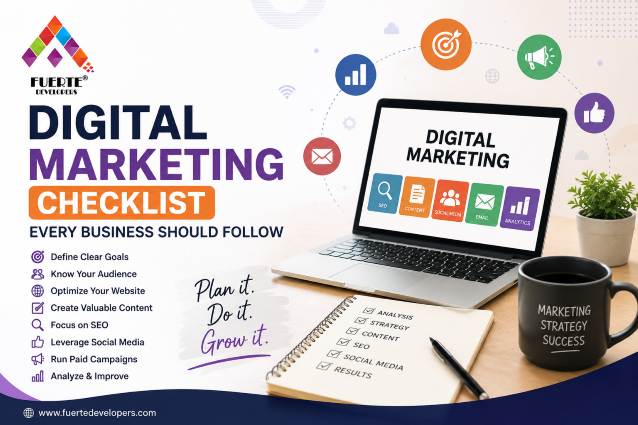
Having a solid online presence does not only mean launching a website and posting from time to time on social media. In today’s world, businesses need an organized approach that integrates websites, search visibility, content, advertising, social media, and communications with customers. Otherwise, the marketing process may become scattered, costly, and impossible to measure.
A digital marketing checklist will help companies to know what they need to work on, what works well, and what needs to be corrected. At the same time, it will help them ensure that the most important points are taken care of while they deal with routine work.
Be it a small business, online store, service company, or growing B2B firm, the following checklist will help to make online marketing more effective.
Define Clear Marketing Goals Before Starting
When planning successful marketing strategies, goals matter a lot. This is because businesses should know what they want to achieve long before investing money in SEO, paid marketing campaigns, content marketing, and social media marketing.
Some companies want to ensure brand recognition while others care about lead generation. E-commerce companies may focus on achieving sales and repeat orders, while local service providers may look for phone calls, visits to the office, and appointment facilitation.
Goals must be smart. For instance, it is not enough to say, “We need more traffic.” It is important to define what traffic is needed and what role the traffic plays. For example, instead of saying “We need to get more leads,” it’s advisable to say that you need the leads that are likely to convert into sales.
When there are clear goals to achieve, it becomes easier to identify effective marketing channels, allocate budgetary resources effectively, and evaluate the results of the marketing strategy implementation.
Understand Your Target Audience
Identifying your target audience is very important for creating an effective online marketing strategy that delivers a message to a specific group of people. After you understand who your customers are and how to reach them, you can create an effective campaign.
First, determine who your ideal customer is. Are they children or adults? Where do they live? What are their hobbies? What job do they have? What problems do they face? How do they make purchases?
There are many sources from which you can gather information about your customers: sales conversations, web analytics, customer feedback, social networks, and even FAQs.
It is also important to understand the intent of a search. For example, while a person that is just looking for general information is at the beginning of his buying journey, a person that is searching for prices and comparisons has probably already made a decision.
Developing Basic Buyer Personas
Buyer personas assist companies in converting audience research into actionable customer profiles. The persona highlights an average customer and contains his/her needs, obstacles, expectations, and decision-making process.
Buyer personas do not have to be intricate; their goal is to guide your team in creating appropriate communications tailored to your future audience.
Once you are completely aware of your target audience, it will be easier for your marketing staff to choose the topics for your blogs, write ads, create social media content, and come up with relevant offers.
Optimize Your Website for Users and Search Engines
Many times, a company’s website is the primary source of their online presence. Although customers can find a business through search engines, ads, emails, social media, or recommendations, it is logical for them to consult the company’s website before making a decision. The website must make it immediately apparent what services are provided by the business and what they should do next.
The company must ensure the website provides ease of navigation, the information is presented in a professional way, the texts are easy to read, the website is loading quickly, and there are appropriate calls to action.
Mobile optimization of a website is equally important. A website that works well on a computer and not well on phones can miss many customers.
When checking the website, one should ensure the following:
- Fast loading speed and mobile responsiveness
- Simple navigation and working links
- Clear calls to action
- Secure HTTPS connection
- Easy-to-use contact and inquiry forms
Build a Strong SEO Foundation
SEO makes it possible for prospective clients to find your business online when looking for relevant products or services.
Effective SEO is not just about stuffing keywords into your website as much as you can. Modern SEO involves the creation of quality content, a properly organized website, smooth technical work, competent use of keywords, internal links, and understanding the purpose of searches. Begin with keyword research to determine what users are looking for. Do not limit yourself to high-volume keywords; sometimes, low-frequency search queries can be very effective in bringing valuable visitors to your site.
Any main page of your website should serve a clearly defined purpose, with useful titles, headings, meta descriptions, URLs, and content aimed at facilitating understanding of the subject matter both for users and search engines. Companies should perform regular checks for broken links, duplicate pages, indexing issues, etc.
Improve Local Search Visibility
For businesses providing services to specific cities and regions, local SEO is very important. Statistics indicate that most customers look for products or services available around them before dealing with a company.
It is therefore imperative that businesses retain consistency in their names, addresses, phone numbers, working hours, and other information on all online platforms that can be used by customers. Furthermore, businesses should encourage positive reviews while also responding to any feedback received.
Location-based page optimization is necessary for businesses that operate in several areas. However, each page must contain valuable and unique content instead of just repeating the same information with only city names being replaced.
Create Content That Solves Real Problems
Effective content marketing implies providing value to the audience. Instead of simply generating articles in order to gain visibility in search engine results, companies should think of content as a way of addressing users’ inquiries and struggles with making purchases.
It is necessary to be aware of various types of useful content. There are blog posts, service pages, videos, guides, FAQs, infographics, and social media posts that can deliver such content.
Every article should serve a purpose. Some may be meant for attracting visitors through search engines, while others are intended to help potential clients choose between the alternatives, get to know the service in question, or feel sure about contacting the company.
One should always keep in mind that quality of content matters more than quantity of mediocre writing. An article that is well-written and genuinely useful will bring traffic and leads for a long time.
Alongside creating new content, it is important to update the existing one. Outdated articles may contain wrong statistics, broken links, old examples, and information different from current needs of clients. Regular updates contribute to improving the accuracy and usefulness of the pages.
Choose the Right Social Media Platforms
What is significant to comprehend is that a number of firms do not succeed in their attempts to use various social media platforms effectively. Choosing correctly implies restricting the use only to those platforms that are popular among the targeted audience.
Today’s social media managers should use methods of advertising as well as other kinds of postings. There should be an appropriate balance between the commercial and informative messages.
Being loyal to the philosophy is important, but it is even more crucial to supply the customers with high-quality products. Social media communication should be interpreted in terms of audiences’ communication.
Build and Maintain an Email List
Through email marketing, businesses are able to communicate directly with their customers and potential customers. Unlike through social media, where the organic reach can be influenced by algorithms, email marketing gives more control of the communication process.
It is important that businesses collect their email lists ethically while also giving the subscribers a detailed description of what to expect.
Businesses may provide useful email content that can include useful educational information, updates regarding the company, announcements about new products, information related to special promotions, or helpful tips on using products from the company.
Dividing email campaigns into segments makes them more relevant. The messages for different clients such as new subscribers, existing customers, dormant customers, and loyal customers may differ significantly.
Use Automation Without Losing the Human Touch
Automating emails enables saving time and providing a uniform experience for customers. Emails of welcome, lead nurturing sequences, reminders of abandoning the cart, messages after purchase, and re-engagement campaigns can all be automated.
However, it is important to ensure that the approach is not mechanical. All messages should be clear, relevant for recipients, and helpful to them.
It is advisable to check all automated campaigns regularly to see whether their content, links, timing, and offers are still up-to-date.
Track Paid Advertising Carefully
Paid advertising allows companies to engage their target audience rapidly, but well-planned, monitored campaigns are essential. It is important to have a clear understanding of your goals, audience, budget, offer, landing page, and conversion before you start any advertising activities.
The ad and the landing page should complement each other. In case you want to promote a specific service and have a customer arrive at a particular page, let it correspond to the ad, and avoid leading them to a simple home page.
Don’t measure campaign results only by impressions or clicks. It is possible to generate huge traffic without getting any business benefits from the promotion. You have to keep an eye on how many leads, sales, conversion rates, costs of customer acquisition, etc. you have.
Experimenting with headings, advertisement formats, target audiences, promotions, and landing pages will help you achieve greater results in the long run.
Improve Your Conversion Rate
Traffic generation is just one step in the marketing journey. Companies have to convert the visitors into customers and prospects as well.
Conversion rate optimization helps in making it easy for people to perform an action like submitting a form, purchasing something, contacting the company, scheduling an appointment, or getting a quote.
Look at your site as if you were a customer. Are the calls to action visible? Are the forms too long? Are prices hard to understand? Are any important questions open?
The amount of trust signals present can affect people’s decisions too. For example, testimonials from customers, reviews, case studies, warranties, and clear policies help with the reduction of uncertainty.
Measure the Right Marketing Metrics
Companies should utilize analytics to inform marketing decisions because without reliable data, it is hard to understand which strategies work and which do not.
Traffic on the website is good; however, this metric should not be considered alone. Companies should take into account the sources of incoming traffic, look at the pages visited, and find out if any key actions were taken.
The most important metrics depend on the business goals. Here are some metrics you might want to focus on:
- Qualified leads and conversion rates
- Costs per lead and customer acquisition costs
- Organic search visibility
- Sales and revenues from campaigns
- Customer retention and repeat purchases.
Do not forget that vanity metrics may not be as useful as you may think. For example, your post may get thousands of views on social media but bring less value to the business than the smaller but focused audience reached through one of your campaigns.
Connect KPIs With Business Objectives
The KPIs must show what business targets are really pursued.
As an example, while a campaign to create brand awareness will put emphasis on reach and engagement, a lead generation campaign, on the other hand, will emphasize qualified inquiries and cost per lead.
It is often more useful to track a limited number of meaningful metrics than to build complex reports consisting of useless numbers.
Review Your Competitors Without Copying Them
By means of competitor analysis, a business can discover great opportunities. It can analyze and evaluate how competitors offer their products, what topics are covered in a blog section, where they appear in search results, and what customers think of them.
The objective is not to copy the design of the website or the commercials, as the research must show what gaps there are.
A competitor may forget to answer one of the important customer questions. Their website can be ineffective in terms of usability, or the content can be too simple. If there are any gaps, they can serve as opportunities for creating a better product/service for customers.
Manage Your Online Reputation
The online reputation of a company has a significant effect on purchasing behavior. Potential buyers tend to check reviews and look for mentions of the brand prior to contacting a business. Thus, it’s advisable to keep track of answers on different platforms and respond accordingly. Good reviews always need to be taken into consideration, while the bad reviews should be processed carefully and professionally.
In some cases, even though a company has received negative feedback, the way the issue is handled can help create a good impression. So it is essential to motivate satisfied customers to share authentic reviews. With steadily collected reviews, it is possible to build trust and reassure future customers.
Protect Customer Data and Marketing Accounts
In every online marketing checklist, it is essential to include security and privacy. Various information about their customers is collected through forms, analytic tools, emails, and online transactions by companies. This information has to be secured.
To ensure safety, companies should use secure websites, strong passwords, and multi-factor authorization systems. Information should be accessed only by authorized professionals, and former employees should not retain rights after termination.
Businesses should know what information they obtain from customers and why they use it. Good data practice is important both from the point of view of the law and to gain customer trust.
Review Your Marketing Checklist Regularly
An online marketing strategy can’t remain constant for an extended period. Customer behavior changes with time, rivals come up with new ideas, search engines implement new algorithms, and advertising platforms get reformed.
It’s good to analyze one’s strategy every month or quarter to reveal what’s doing well and what needs adjustments. Bear in mind your website, SEO results, the content you utilize, social networks, email messages, advertisements, lead quality, and the ROI in general.
There’s no need to change one’s strategy every time a new trend appears. It is necessary to use data and business goals to determine what has to be taken care of.
Conclusion
Drafting a digital marketing checklist will allow businesses to have a practical solution to the problem of building their online presence. The aim is not to apply all marketing instruments that are available but to select the appropriate ones. Above all, concentrate on measuring the outcomes that are relevant to your business. Effective online marketing does not happen due to one successful campaign or one viral story. It develops through continuous improvements, continuous testing efforts, effective communication, and readiness to adjust based on actual performance metrics. When businesses change their approach from an ad-hoc marketing behavior to a systematic checklist, they will make better decisions and minimize waste.