


Introduction: The Power of Being Recognised
In India, the Micro, Small, and Medium Enterprises (MSME) sector is the backbone of the economy, driving innovation and employment. The government actively supports these businesses through various schemes and incentives. For Indian freelancers and nascent startups, officially registering as an MSME (now through Udyam Registration) is not just a formality—it’s a strategic move that unlocks a multitude of benefits crucial for growth and sustainability.
Often, small businesses and freelancers, especially those operating solo or with minimal overhead, overlook this simple yet powerful step. They might not realise that even a single-person consulting firm or a small e-commerce startup can qualify.
This guide will break down the most significant benefits of MSME registration for Indian freelancers and startups, explaining why this simple step can dramatically change your business trajectory.
What is MSME Registration (Udyam Registration)?
MSME Registration is a free, paperless, and instant online process through the Udyam Registration portal (udyamregistration.gov.in). It replaced the old Udyog Aadhaar Memorandum (UAM) system.
The classification of MSMEs is based on investment in plant & machinery/equipment AND annual turnover:
| Enterprise Type | Investment in Plant & Machinery/Equipment | Annual Turnover |
| Micro | Not more than ₹1 Crore | Not more than ₹5 Crore |
| Small | Not more than ₹10 Crore | Not more than ₹50 Crore |
| Medium | Not more than ₹50 Crore | Not more than ₹250 Crore |
Key Takeaway: Even a freelancer with minimal equipment investment and low turnover can register as a Micro Enterprise.
7 Key Benefits of MSME Registration for Freelancers & Startups
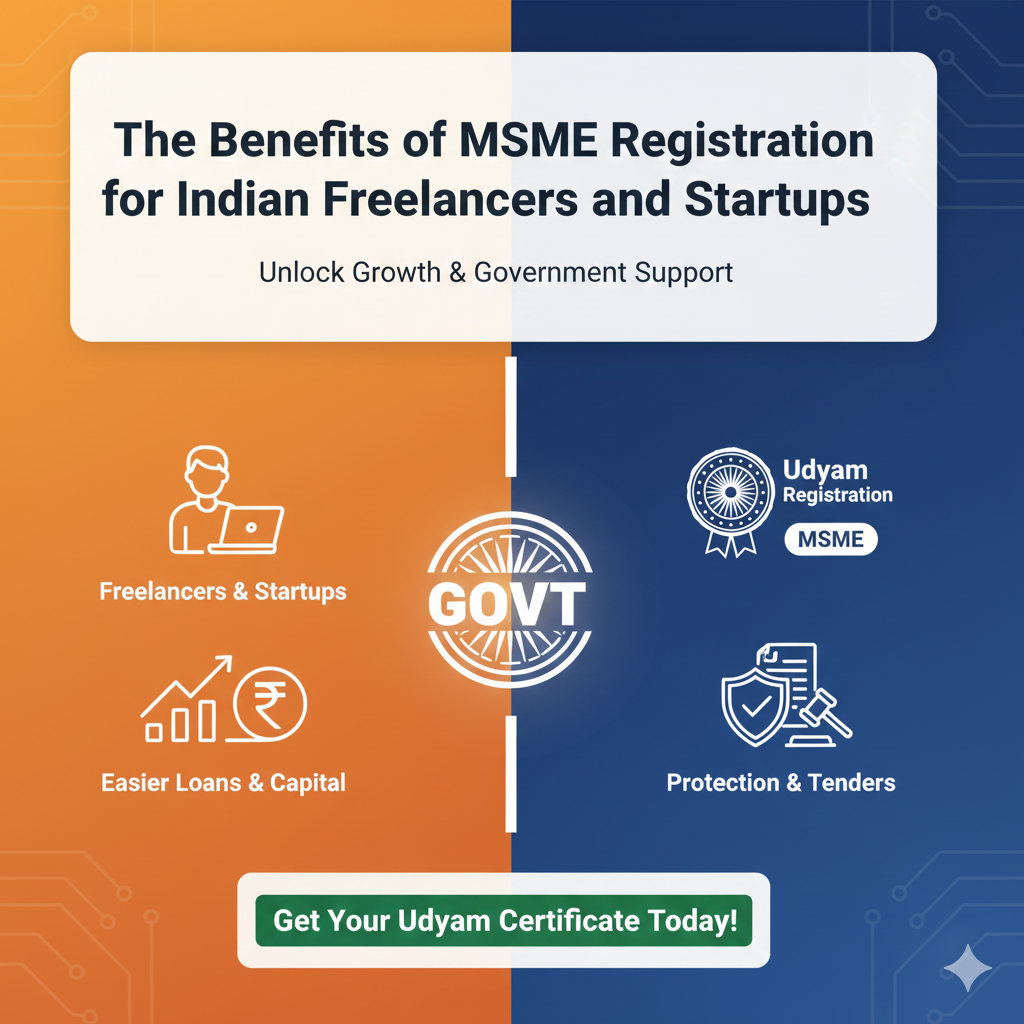
Benefit 1: Priority Sector Lending (Easier & Cheaper Loans)
- How it Helps: Banks are mandated by the Reserve Bank of India (RBI) to lend a certain percentage of their funds to the MSME sector. This means MSME-registered businesses get preferential treatment when applying for loans.
- Advantages: Easier access to credit, lower interest rates, and often less stringent collateral requirements compared to non-MSMEs. Government schemes like MUDRA loans are specifically for MSMEs.
Benefit 2: Protection Against Delayed Payments
- How it Helps: The MSME Development Act, 2006, includes provisions to protect MSMEs from delayed payments from buyers.
- Advantages: If a buyer (especially larger companies or government departments) delays payment beyond a specified period (typically 45 days), the MSME can claim interest on the delayed amount at a rate three times the bank rate, and has recourse through MSME Facilitation Councils.
Benefit 3: Reduced Patent & Trademark Filing Fees
- How it Helps: Innovation is key for startups. The government incentivises MSMEs to protect their intellectual property.
- Advantages: Significantly reduced fees for filing patents and trademarks, making it more affordable for freelancers and startups to secure their unique ideas and brand names.
Benefit 4: Eligibility for Government Tenders & Schemes
- How it Helps: The government actively promotes procurement from MSMEs.
- Advantages:
- Reservation Policy: Certain goods and services are exclusively procured from MSMEs.
- Tender Exemptions: MSMEs can be exempted from paying earnest money deposit (EMD) and security deposits when bidding for government tenders.
- Specific Schemes: Access to schemes like Public Procurement Policy, various export promotion schemes, credit guarantee schemes, and infrastructure development support.
Benefit 5: Concessions on Electricity Bills & ISO Certification
- How it Helps: Reduces operational costs and enhances credibility.
- Advantages: Some states offer subsidies on electricity bills. MSMEs can also avail financial support for obtaining ISO certification, which boosts their market reputation and quality standards.
Benefit 6: Bank Overdraft Facility with Lower Interest Rates
- How it Helps: Provides quick access to working capital.
- Advantages: MSME-registered businesses often qualify for an overdraft facility from banks, offering a flexible credit line at lower interest rates to manage short-term cash flow needs.
Benefit 7: Support for Foreign Trade and Export
- How it Helps: Encourages MSMEs to expand globally.
- Advantages: Access to various government schemes and subsidies aimed at promoting MSME exports, including participation in international trade fairs and market development assistance.
How to Get Your Udyam Registration (Simple Steps)
Getting registered is remarkably straightforward:
- Visit: Go to udyamregistration.gov.in.
- Aadhaar Number: You only need your Aadhaar Number (of the proprietor/managing partner/director).
- PAN & GST: PAN is mandatory for registration. GSTIN is optional for now, but will be required from April 1, 2021 (for turnover exceeding the limit).
- No Documents Upload: The process is fully paperless and self-declaratory.
- Get Certificate: Upon completion, you will instantly receive your Udyam Registration Certificate with a permanent identity number.
Conclusion: Don’t Miss Out on Growth Opportunities
For Indian freelancers and startups, MSME (Udyam) Registration is far more than a bureaucratic step. It’s a gateway to critical financial support, legal protection, and market opportunities that can significantly accelerate your growth trajectory. By leveraging the government’s commitment to small businesses, you’re not just registering; you’re strategically positioning your enterprise for long-term success. Don’t leave these benefits on the table—get your Udyam Registration today.