



When leads really do start flowing into the businesses, many believe they’re growing as the dashboard is full of more numbers and the campaign reports look great and the marketing department can celebrate. Then when they look at their revenue a few months later, there is little to no change in the revenue they received.
It is at this point many companies discover the sad reality that the generation of leads vs customer acquisition are two very different things. The generation of a lead and customer acquisition are some of the most frequent mistakes that businesses make today in their marketing practices and processes.
The difference between the generation of leads and customer acquisition isn’t just a terminology issue. The impact of understanding this important difference brings you increased measurable success, different budget allocation, and the ability to build your long term growth engine.
What Is Lead Generation?
Identifying and capturing potential clients’ interest through lead generation is how you identify potential clients. A lead is just someone who has expressed some level of interest in your offerings, such as the following:
- A completed request form
- Resource download
- Clicking on a CTA
- Subscribing to a newsletter
- Demo request
At this point, no purchase has taken place yet, only interest/intent has been expressed. Lead generation begins this conversation.
What Is Customer Acquisition?
Acquiring a new customer can be described as converting that interested individual into a purchased product. Once your lead has entered into your sales funnel and has followed the steps referred to above, qualifying the lead and performing follow-up activities, completing the sales conversation, arriving at a product trial/evaluation, and finally making the purchase, you have acquired a new customer. At this point, you can say that you have performed all the steps involved in acquiring a new customer.
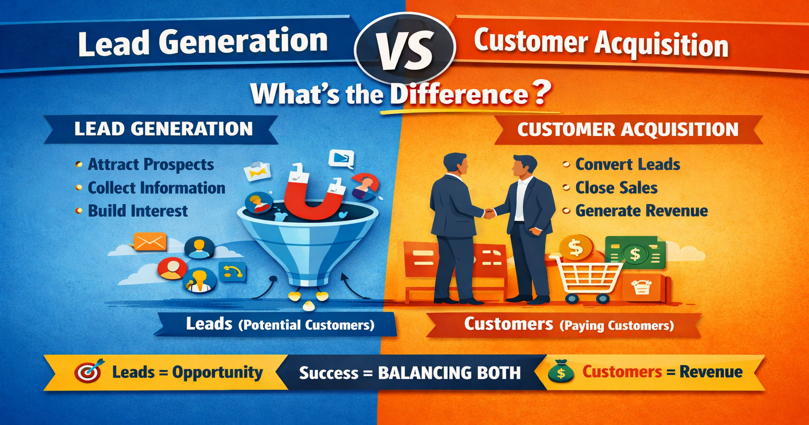
Basically: Lead generation creates opportunities. Customer acquisition creates revenue.
What Is the Difference Between Lead Generation and Customer Acquisition?
Customer acquisition and lead generation represent two separate steps in a marketing and sales process, but they are also very interrelated.
- Lead Generation—The purpose of lead generation is to identify potential customers and create a contact database of those leads through various marketing methods (digital advertising, content campaigns, and social media) to create a large list of prospects, or leads, all of whom have expressed varying degrees of interest in the company’s products and/or services.
- Customer Acquisition—It will take the next step by converting those leads into actual customers who are spending money on a company’s products or services; doing so requires continued customer engagement strategies such as lead nurturing, personalized communication, and offering specific products or services designed to cause a lead to convert into a customer.
Ultimately, lead generation is responsible for providing potential customers either directly or indirectly through additional sources to your sales funnel; whereas customer acquisition is responsible for taking those potential customers through the remainder of the funnel in an effort to close sales and generate revenue.
Strategies of Lead Generation vs. Customer Acquisition
The lead generation and customer acquisition strategies differ based on how they are executed; specifically, lead generation collects prospects (people who may buy from you) while customer acquisition converts those prospects into customers (people who have bought from you).
Lead generation strategies are used to generate prospects, which is the ultimate goal of lead generation, using both inbound and outbound tactics. Inbound tactics include using content marketing (creating interesting blog posts, optimized website content) and search engine optimization (SEO) to attract and engage website visitors and generate leads for your business.
Lead generation can also be accomplished through outbound tactics such as direct email marketing, telemarketing, and targeted advertising to actively recruit prospects for your business.
To generate as many leads as possible, conversion optimization is essential. When creating a landing page for lead generation, you can maximize the likelihood of converting visitors to leads by correctly designing the layout and functionality of the page. You can also test various calls to action to find which ones have the highest success rate at converting visitors to leads.
Customer acquisition strategies will turn leads into customers once they have made their purchase decision. In this phase of customer acquisition, lead nurturing through both inbound and outbound strategies will occur. Inbound lead nurturing focuses on directing personalized email marketing campaigns and creating content that is specific to the lead’s needs and behaviors. Outbound lead nurturing is carried out through direct sales or through engaging the lead in networking through event opportunities, at which time a sales associate will try to engage the lead in a conversation about how their product would provide a solution for their problem, etc.
A complete conversion optimization map of the customer’s journey will be created in customer acquisition to determine WHERE and HOW to improve touch points in the customer’s journey.
A multi-channel marketing approach must be used to ensure a seamless experience with different marketing channels in order to promote converting the lead into a customer. In addition to this, using data-driven decision-making based on the reporting, such as arithmetic, to continuously monitor the performance of CAC (Customer Acquisition Cost), Conversion Rate, and CLV (Customer Lifetime Value) is important to ensure that customer acquisition programs are effective and sustainable.
Key Metrics of Lead Generation vs. Customer Acquisition
There are various metrics that can be used when evaluating the effectiveness of lead generation and customer acquisition driving factors. For lead generation, the three main metrics to track include cost per lead (CPL), which is the average amount spent acquiring a lead; visitor to lead conversion rate, which shows what percentage of website visitors have converted into leads; and click through rates (CTR) on each individual campaign, which provides insight into how engaging an advertisement/e-mail is to prospective customers. The percentage of visitors who complete an action on a particular landing page is referred to as the conversion rate, and this metric will allow the evaluator to determine how well the landing page is designed and how appealing the offer is to the prospective customer when using the corresponding ad to get there. Finally, lead quality is measured in order to determine the likelihood a lead will eventually become a buyer. Lead quality can be determined by scoring leads based on their engagement with your content as well as their demographic profile compared with your company’s ideal target audience. Although there are numerous other types of metrics that could be tracked, these three lead-generation metrics are the most important to track.
Data is used to track the effectiveness and cost to acquire each customer via lead (prospect). CAC (Customer Acquisition Cost): all costs associated with the acquisition of a new customer), including all sales and marketing costs, gives you a perspective of how much you must spend on acquiring customers in order to grow your customer base.
You should also closely monitor the conversion rate (from lead to customer) to see how effectively your marketing funnel and sales process are nurturing and converting leads into customers.
CLV (Customer Lifetime Value) is an estimation of the total amount of revenue your business will receive from an individual customer during their relationship with your business and helps you understand the importance of long-term value in terms of your customer acquisition strategy.
Churn rate (the number of customers who cease doing business with you over a specified period) indicates how effective your customer-retention efforts are; and revenue per customer helps you determine whether each customer is profitable for your business, which has a direct impact on decisions related to pricing and sales strategy.
It is vital that you evaluate how good of a prospective customer the lead is while they are being developed so that you can improve your overall ability to sell them and obtain new customers. When the lead qualifies as a “high-quality lead,” it is much more likely to convert into a customer; thus, your overall CPL and CPA would be reduced.
There are several methods for evaluating a lead’s quality, such as scoring leads, which assigns a point value to leads based on criteria that are important to your company. Surveys may include responses to your marketing materials, website activity, and demographic information but must also be compared against your historical data on what has happened statistically regarding whether previous similar leads have purchased or not purchased. If you can confirm that a lead is most likely going to become a customer, you are able to put in place the correct marketing and sales strategies to help close the sale or transact with each lead you are developing.
Should Your Business Focus On Customer Acquisition Or Lead Generation?
There are many factors to consider when deciding whether to pursue customer acquisition or lead generation as your primary source for growing your business: stage of growth, overall marketing objectives, and available resources are just some of the many elements involved. For companies that are new or entering new markets, lead generation will probably be the initial strategy used in order to create awareness and fill the sales funnel. For companies that are already established, customer acquisition will likely be the first focus for converting the leads they’ve generated from existing opportunity pipelines into actual paying customers and receiving the greatest return on their marketing investment.
Although individual companies may fall into one of the previous categories, in reality the majority of businesses will find that a combination strategy of using both lead generation and customer acquisition is optimum. Simply generating more leads without having an effective conversion strategy in place will yield unmeasured results; conversely, generating conversions without a steady influx of new prospects from your lead generation efforts will equally yield unmeasured results. Implementing a strategy that combines the two functions of lead generation and customer acquisition (and continuously evaluating your performance relative to defined performance metrics such as conversion rates and customer lifetime value) ultimately provides companies with the flexibility to make the necessary changes to their strategies in order to maximize their overall performance (ROI) based on prevailing economic conditions and company objectives.
Conclusion
The functions of lead generation versus customer development are different—leads represent interest, and customers provide income.
If you only focus your attention on either side of the equation, there will be an imbalance; therefore, both must work together to bring in new customers by successfully converting those people into long-term clients.
Ultimately, your success will depend on building your pipeline of leads into a loyal customer base through the proper process and performance.