


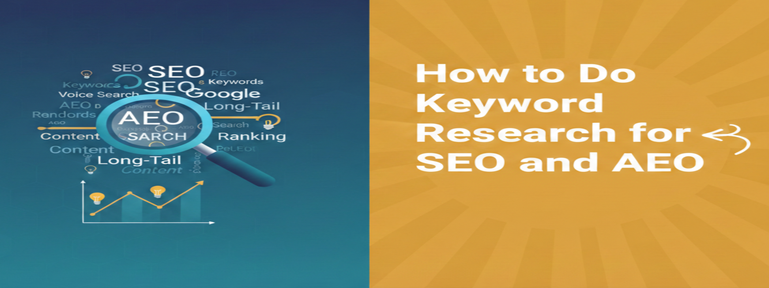
Keyword research used to be simple. Find a keyword, write an article, and rank on Google. That approach doesn’t work anymore.
Today, people don’t just search. They ask questions. They talk to their phones. They expect instant answers. And search engines don’t just show links, they show solutions.
That’s why modern keyword research must balance SEO and AEO.
What Keyword Research Really Means Today
Keyword research is not about finding “popular words.”
It’s about understanding:
- what people are trying to solve
- how they phrase their problems
- and what kind of answer they expect
For example:
- Someone searching “keyword research tools” wants options
- Someone searching “how to do keyword research” wants guidance
Both are valuable, but they need different content styles. That’s the key difference between SEO and AEO.
SEO vs AEO: Same Goal, Different Approach
SEO focuses on visibility.
AEO focuses on clarity.
SEO helps your page show up.
AEO helps your page get chosen as the answer.
When done right, they support each other. Think of SEO as getting invited into the room and AEO as being the person everyone listens to once you’re there.
SEO vs AEO Keyword Research
| SEO Keyword Research | AEO Keyword Research |
| Focuses on rankings | Focuses on answers |
| Short & mid-tail keywords | Long-tail & question keywords |
| Traffic-driven | Intent-driven |
| Blog & landing pages | FAQs, snippets, voice search |
| Google SERPs | Google + AI + Voice |
Best strategy: Combine both SEO & AEO
Step 1: Always Start With Search Intent
Before using any tool, stop and think: Why is someone searching this?
Most keywords fall into one of these intent types:
- Learning something
- Comparing options
- Solving a problem
- Buying or signing up
AEO keywords are usually learning or problem-based. SEO keywords can be learning-based or commercial. If your content doesn’t match intent, rankings won’t matter.
Step 2: Write Down Simple Seed Ideas (No Tools Yet)
This step is often skipped, and that’s a mistake.
Open a blank page and list:
- what your audience struggles with
- what they ask you repeatedly
- what beginners usually don’t understand
These become your seed keywords. They don’t need to be perfect. They just need to be real. Tools work best after this step, not before it.
Step 3: Keyword Tools Are Useful, But Don’t Let Them Control You
Keyword tools are helpful, but they’re not the be-all and end-all.
Use them to:
- Find words that are alike
- See how often people search for stuff
- Size up the other people
Don’t just go for keywords that everyone searches for. Sometimes, the smaller, super-focused keywords are way better than the usual ones.
Step 4: Find Question Keywords (This Is Where AEO Wins)
Want your stuff to pop up in:
- Those little answer boxes
- Voice searches
- AI answers
Then, use keywords that are questions.
Look for phrases that start with:
- how
- what
- why
- is
- can
That’s how people talk, mainly on their phones with voice search. These keywords tend to be longer, which makes them work really well.
Step 5: Check Out the Competition the Right Way
Instead of asking, “Is this keyword hard?”
Ask, “Can I explain this better than what already exists?”
Go to the pages that are already ranking and see:
- Are the answers easy to understand or confusing?
- Is the info old?
- Does the page really answer the question?
If you can explain something in a simpler, clearer, or more complete way, you have a shot at ranking.
Step 6: Group Keywords by Topic, Not Random Posts
One page should not try to rank for everything.
Instead:
- Choose one main keyword
- Support it with closely related terms
- Answer related questions on the same page
This helps search engines understand, “This page truly knows this topic.”
That’s how topical authority is built slowly but powerfully.
Step 7: Write for Humans First, Algorithms Second
Most guides won’t tell you this, but search engines are getting good at spotting writing that is actually helpful. They don’t care about keyword tricks.
So:
- Use keywords like you normally would
- Explain things like you would if you are talking to someone in person
- Don’t say the same things too often. It will confuse the reader.
Easy-to-understand explanations are better than trying to stuff in keywords.
Step 8: Add Clear Answers for AEO
If your page answers questions in a very clear way, it has a better shot at becoming a top result.
Here’s how:
- Keep your paragraphs short
- Use bullet points
- Put your answers close to the headings
- Keep the language simple
If someone can quickly skim your page and get the main idea, that’s a really great sign.
Step 9: Check and Improve Regularly
Keyword research isn’t something you just do once. Search habits change. Questions change. There’s always new competition.
Check your content every few months and ask:
- Is this still correct?
- Are people asking new questions?
- Can I explain this better?
Small updates can make a big difference.
Common Mistakes to Avoid
- Only chasing popular keywords
- Ignoring searches that are questions
- Writing content that sounds smart but doesn’t explain anything
- Using too many keywords instead of answering the question
- Forgetting that people read your content first
Avoid these mistakes, and you’re already doing better than most sites.
Final Thought
Good keyword research doesn’t have to be complicated. It feels like understanding people. When you know what someone is trying to figure out, and you explain it clearly, SEO and AEO happen naturally. That’s how sustainable rankings are built.