


Performance marketing in 2026 is no longer about getting more clicks, more traffic, or more leads. Businesses today operate in a far more competitive, data-heavy, and cost-sensitive environment. Advertising platforms are smarter, users are more selective, and marketing budgets are under more scrutiny than ever before.
In this reality, marketing success is no longer defined by activity — it is defined by efficiency, profitability, and scalability. A campaign that generates thousands of clicks but loses money is not a successful campaign. A funnel that produces cheap leads but no paying customers is not a growth system.
The smartest companies in 2026 treat marketing like a financial investment, not like a branding experiment. They track metrics that directly connect marketing spend to revenue, margins, and long-term business value.
What Performance Marketing Really Means in 2026
Performance marketing has evolved into a full-funnel revenue optimization system. It no longer lives only inside ad accounts. Today, it includes traffic acquisition, landing page experience, conversion optimization, CRM automation, retargeting, and retention strategies — all measured as one connected growth engine.
Every rupee spent must justify itself. Every campaign must prove its impact on pipeline and revenue. This shift has happened because companies can no longer afford to scale blindly. The brands that win in 2026 are the ones that understand not just how to get customers, but how to get them profitably and predictably.
Why Most Businesses Still Track the Wrong Numbers
Many businesses still rely on dashboards filled with impressions, clicks, CTR, and cost-per-click. These numbers look good in reports, but they rarely answer the most important business questions: Are we making money? Can we scale this? Are we growing efficiently?
The problem with these metrics is not that they are useless — it is that they are incomplete. They describe what is happening on the surface, but they do not describe what is happening to the business. A marketing system should be judged the same way a business is judged: by its ability to generate profitable growth.
The Core Metrics That Actually Matter in 2026
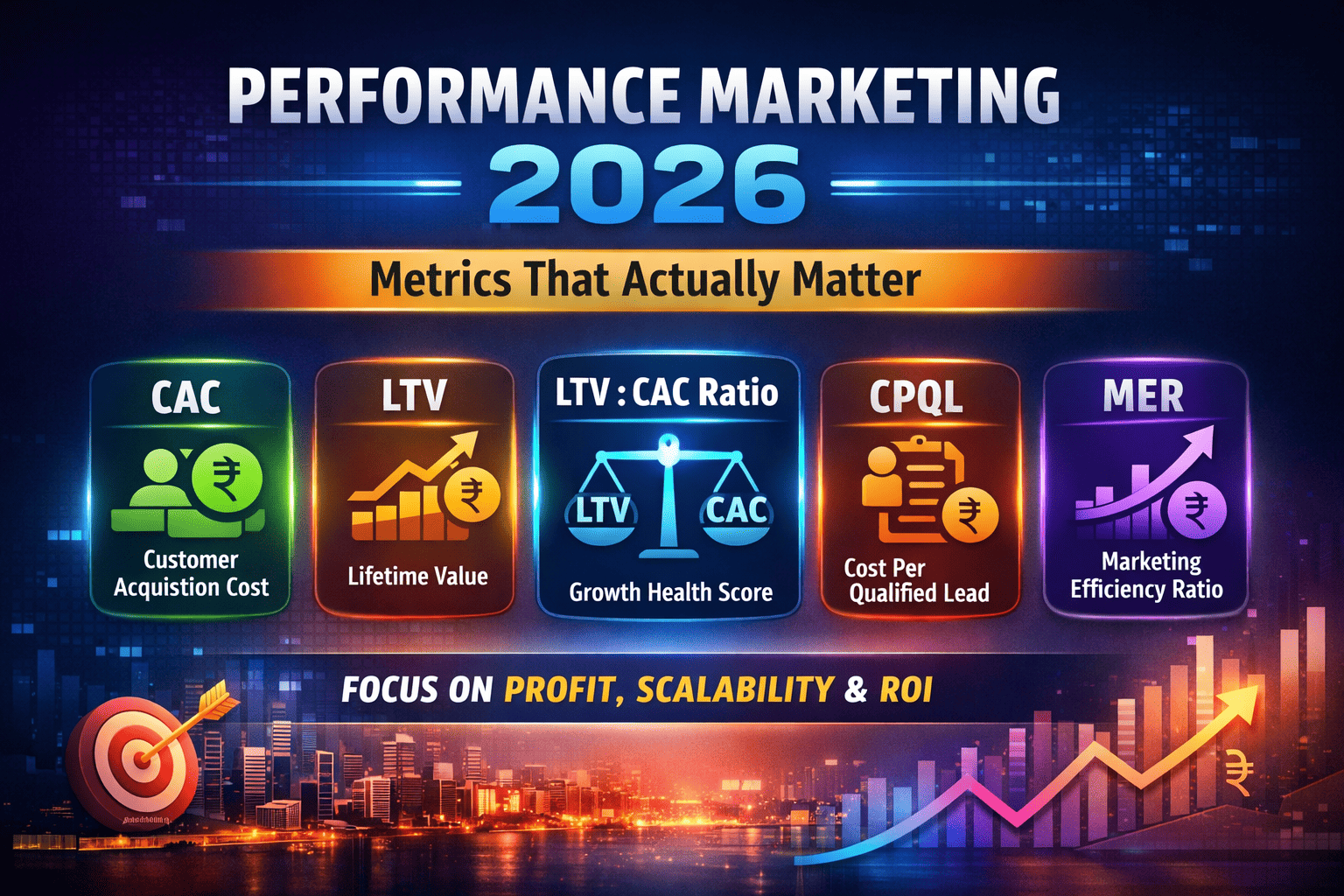
In modern performance marketing, only a small set of metrics truly define success. These metrics focus on unit economics, scalability, and long-term value, not short-term activity.
Customer Acquisition Cost (CAC)
Customer Acquisition Cost represents the total cost of acquiring one paying customer across marketing and sales. In 2026, this metric has become central because ad platforms are more competitive and customer attention is more expensive. If your CAC is rising faster than your revenue per customer, your business is slowly moving toward a ceiling it cannot break.
Lifetime Value (LTV)
Lifetime Value measures how much revenue a customer generates over their entire relationship with your business. This metric has become more important than ever because retention, repeat purchases, and upsells now define whether a business can scale safely. Companies that focus only on acquisition and ignore LTV eventually collapse under rising costs.
LTV to CAC Ratio
The relationship between LTV and CAC is now considered the true health score of a business. A company with strong revenue but a poor LTV:CAC ratio is not actually healthy — it is just burning fuel faster. In 2026, investors, founders, and smart marketers all look at this ratio before scaling.
Cost Per Qualified Lead (CPQL)
In most businesses, not all leads are equal. CPQL measures the cost of acquiring leads that actually match your ideal customer profile and have real buying intent. This metric has replaced basic CPL because volume without quality creates false growth and sales team frustration.
Marketing Efficiency Ratio (MER)
MER shows how much revenue is generated for every rupee spent on marketing. Unlike ROAS, which is channel-specific, MER shows total marketing efficiency across all platforms. In 2026, this metric is crucial because attribution is fragmented and customer journeys are non-linear.
The Metrics That Mislead Most Businesses
While some surface-level metrics still have operational value, they should never be used as success indicators.
Impressions and reach only show visibility, not business impact
Clicks and CTR show interest, not buying intent
Cost per click shows traffic efficiency, not revenue efficiency
Follower growth shows audience size, not monetization strength
These metrics are useful diagnostics, but dangerous targets.
Performance Marketing Metrics That Matter vs Vanity Metrics
| Vanity Metrics (Misleading) | Business Metrics (Real Growth) |
|---|---|
| Impressions | Customer Acquisition Cost (CAC) |
| Clicks / CTR | Lifetime Value (LTV) |
| Cost Per Click | LTV : CAC Ratio |
| Cost Per Lead | Cost Per Qualified Lead (CPQL) |
| ROAS (Channel) | Marketing Efficiency Ratio (MER) |
| Follower Growth | Revenue Growth & Retention |
How Smart Companies Build Their Marketing Dashboard in 2026
Instead of tracking dozens of numbers, modern companies focus on:
Profitability per customer
Scalability of acquisition
Predictability of revenue
Retention and expansion revenue
Efficiency of total marketing spend
This makes decision-making faster, clearer, and far more strategic.
How Fuerte Developers Approaches Performance Marketing
At Fuerte Developers, we don’t optimize for clicks or leads. We build revenue systems. Our focus is always on improving unit economics, increasing LTV, lowering CAC, and making growth predictable and scalable.
Conclusion
In 2026, the businesses that truly win are not the ones with the most traffic or the loudest campaigns — they are the ones with the strongest economics behind their growth. Real success comes from understanding exactly how much it costs to acquire a customer, how much that customer is worth over time, and how efficiently your marketing engine converts investment into revenue.
If your marketing dashboard doesn’t clearly show you profitability, scalability, and growth efficiency, then it isn’t helping you make better decisions — it’s just reporting activity. At Fuerte Developers, we help businesses move away from vanity metrics and build performance marketing systems that are driven by real business outcomes, not surface-level numbers — so growth becomes predictable, scalable, and profitable.
Need a Performance-Driven Social Media Strategy for Your Business?
Follow Us | Our Services | Contact Us