


The Startup’s Mobile Dilemma
In today’s mobile-first world, having an app is almost a necessity for startups. But faced with limited budgets and tight timelines, many founders hit a dilemma: should they build a costly native app for iOS and Android, or opt for a single, web-based solution?
Enter Hybrid App Development—a powerful middle ground that offers the best of both worlds. For startups, it’s a strategic choice that can deliver a near-native experience, wider reach, and significant cost savings.
This complete guide will break down what hybrid apps are, why they’re ideal for startups, the top frameworks to consider, and how to leverage this approach for rapid, cross-platform success.
What Exactly is a Hybrid App?
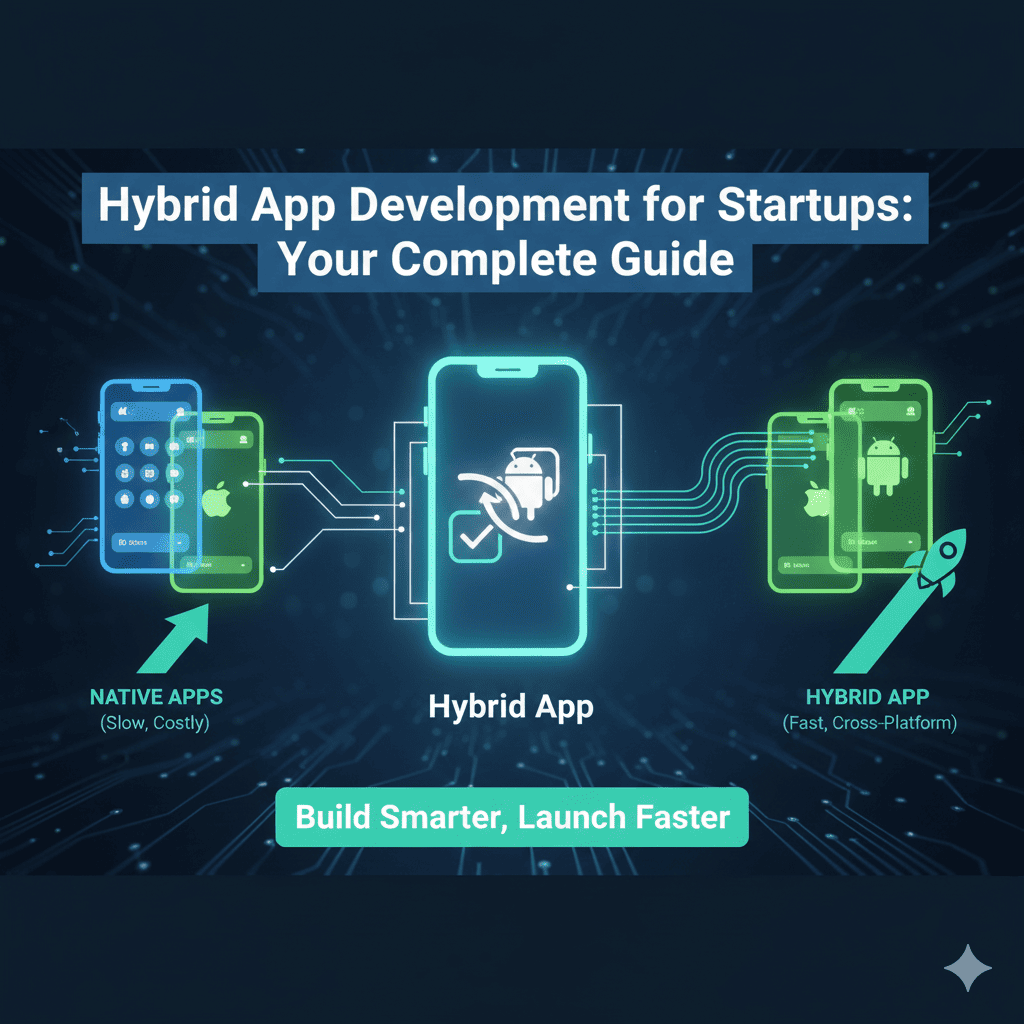
Imagine building a website that behaves like a native app. That’s essentially what a hybrid app is.
- Core Concept: Hybrid apps are developed using web technologies (HTML, CSS, JavaScript) and then wrapped in a native container (like Capacitor or Cordova). This container allows the web-based code to be packaged into a native application, which can then be distributed through app stores (Apple App Store, Google Play Store).
- The “Wrapper”: The app runs inside a WebView (an embedded browser) within the native shell, giving it access to native device features (camera, GPS, notifications) via plugins.
Why Hybrid App Development is Ideal for Startups
For startups, every dollar and every day counts. Hybrid app development offers compelling advantages:
1. Cost-Efficiency
* **Single Codebase:** You write code once using web technologies, which runs on both iOS and Android. This drastically cuts development costs compared to building two separate native apps.
* **Smaller Team:** You typically need fewer developers (or a smaller skill set) compared to maintaining separate iOS (Swift/Objective-C) and Android (Kotlin/Java) teams.
2. Faster Time-to-Market (Speed)
* **Rapid Development:** Leveraging familiar web technologies allows for quicker iteration and deployment cycles.
* **Simultaneous Release:** Launch on both major app stores almost simultaneously, reaching a wider audience from day one.
3. Wider Audience Reach
* By deploying on both iOS and Android, you immediately access ~98% of the global smartphone market.
4. Easier Maintenance & Updates
* Updating the web code often means changes apply instantly to both platforms (sometimes without requiring a full app store update, depending on the architecture).
* Debugging can be simpler within a familiar web environment.
5. Access to Native Features
* While primarily web-based, hybrid frameworks provide plugins and APIs to access device hardware (camera, GPS, accelerometer, push notifications) and software capabilities.
6. Familiar Technologies
* Many developers are already proficient in HTML, CSS, and JavaScript, making it easier to find talent or upskill existing web developers.
Top Hybrid Frameworks for Startups
Choosing the right framework is crucial. Here are the leading options:
1. React Native (Backed by Facebook)
* **How it Works:** Uses JavaScript (React) to build native-rendering mobile apps. Your code is compiled to actual native UI components, not just a WebView.
* **Pros for Startups:** Large developer community, excellent performance (closest to native feel among hybrids), hot reloading, vast ecosystem of libraries.
* **Best For:** Startups needing high performance and a native look-and-feel without building separate native apps.
2. Flutter (Backed by Google)
* **How it Works:** Uses Google’s Dart language and renders its UI directly with its own engine, offering pixel-perfect control and consistent UI across platforms.
* **Pros for Startups:** Extremely fast development with hot reload, stunning and customizable UI, excellent performance.
* **Best For:** Startups prioritising beautiful, highly custom UIs and very fast development cycles, willing to learn Dart.
3. Ionic (Built on Web Components)
* **How it Works:** Uses web technologies (HTML, CSS, JavaScript) and integrates with frameworks like Angular, React, or Vue.js. It runs inside a WebView.
* **Pros for Startups:** Very fast to develop, leverages web development skills directly, good for content-heavy or simpler apps.
* **Best For:** Startups looking for the quickest entry into the app store, especially if they have existing web assets or web development teams.
When to Consider Native (And When Hybrid is Enough)
While hybrid is great, it’s not always perfect.
- Choose Hybrid If:
- Budget and time-to-market are critical.
- Your app doesn’t require complex 3D graphics, heavy animations, or direct, low-level hardware interaction (e.g., advanced AR/VR).
- You need to reach both iOS and Android users with a single codebase.
- Your app is content-driven, e-commerce, social, or utility-focused.
- Consider Native If:
- Your app is extremely graphically intensive (high-end gaming).
- It requires bleeding-edge performance or direct, complex, device-specific hardware integration (e.g., advanced camera features, unique sensors).
- You have a very large budget and a specialised team for each platform.
Conclusion: Your Strategic Mobile App Launchpad
For most startups, hybrid app development represents a powerful, pragmatic, and cost-effective strategy to launch a high-quality mobile application. By carefully selecting a framework like React Native or Flutter, you can bring your vision to life faster, reach a broader audience, and conserve precious resources—setting a strong foundation for your mobile presence and future growth.
Maximise your Knee Replacement recovery! Get essential diet tips for healing (protein, anti-inflammatory foods) and critical lifestyle steps for mobility and joint longevity.
Knee Replacement, TKR Recovery, Post-Op Care, Diet After Knee Surgery, Anti-inflammatory Diet, Protein for Healing, Physical Therapy, PT Exercises, Joint Longevity, Weight Management, Mobility Tips, Home Safety, Fall Prevention