


AI was once only available for big companies with deep pockets; however, AI-enabled marketing solutions are now available for small companies to use to get customers, effectively communicate with their audience, reduce time spent on administrative tasks, and boost revenue, often at an unexpectedly low price.
AI can also provide small businesses with ways to automate social media posts and develop customized e-mail campaigns so they can work smarter, not harder, than their competitors do.
Why AI Marketing Matters for Small Businesses
Small business owners experience similar difficulties related to advertising expenses, time constraints, a limited number of employees, creating consistent content over time, and managing several online channels at once. Because of these barriers, competing in the modern digital landscape may be challenging for many businesses. AI marketing tools can assist in addressing these challenges through automated repetitive work, increased productivity, and easier marketing procedures. The use of AI allows small business owners to develop content faster, create a more engaging experience for customers, and run their campaigns with less effort and at lower costs.
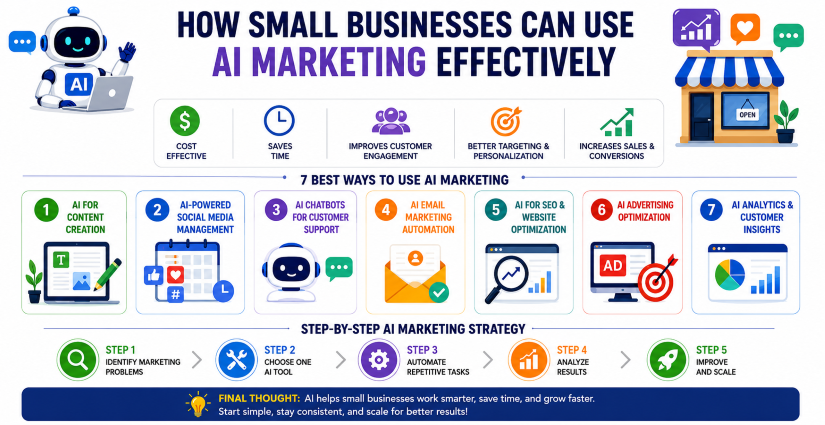
Key Benefits of AI Marketing
| Benefit | How It Helps |
| Time Saving | Automates repetitive tasks |
| Better Customer Insights | Analyzes customer behavior |
| Personalized Marketing | Creates targeted campaigns |
| Improved Content Creation | Generates blogs, captions, emails |
| Cost Efficiency | Reduces need for large teams |
| Higher Engagement | Delivers smarter recommendations |
Best Ways Small Businesses Can Use AI Marketing
1. AI for Content Creation
AI content tools assist small businesses in rapidly generating materials such as blog posts, captions for social media posts, product descriptions, email communications, and ad copy. For example, companies can use ChatGPT, Jasper AI, Copy.ai, etc., to quickly create consistent content. This allows small businesses to save a lot of time and resources creating content.
2. AI-Powered Social Media Management
Companies employ AI Social Media tools to automate and streamline several different tasks, such as scheduling posts, creating captions for posts, measuring engagement on digital content posted, and tracking the latest trends. Social Media Management Tools like Buffer, Hootsuite, and Later enable businesses to have an easier time managing their social media platforms, to have a unified online image/identity, and to be consistent with the content they produce across all of the various digital platforms where they are present.
3. AI Chatbots for Customer Support
AI Chatbot Tools help make it easier for customers to interact with businesses by answering a customer’s frequently asked questions instantaneously, booking an appointment, providing product recommendations, and automatically generating leads. Some of the most well-known AI Chatbot Tools are Tidio, Intercom, and Drift.
4. AI Email Marketing Automation
AI used in Email Marketing makes your emails more personalized, helps to create better subject lines, and improves automated processes. Platforms such as Mailchimp, Brevo, and Klaviyo allow companies to improve engagement levels, as well as increase revenue per user.
5. AI for SEO and Website Optimization
There is a growing number of SEO tools that allow businesses to utilize AI to help them achieve higher rankings in search engines by leveraging the words users search for when looking for information on the internet, what content is relevant to those searches, and what’s relevant to their business’s competitors. Examples of such platforms include Surfer SEO, Semrush, and Ahrefs.
6. AI Advertising Optimization
By utilizing an ad platform that uses AI, you can make more precise and deliberate decisions about where to run your ads by optimizing the bid process and analyzing performance across different advertising networks (e.g., Google, Facebook). For business owners, examples of advertising platforms include Google Ads and Meta Ads Manager.
7. AI Analytics and Customer Insights
As a result of using an analytics platform that is powered by AI, businesses can gain insight into their customers’ behaviour and how that behaviour affects their advertising and marketing strategies. Popular examples of analytic platforms include Google Analytics and Hotjar .
Step-by-Step AI Marketing Strategy for Small Businesses
1. Identify Marketing Problems
The best way to begin identifying problems of marketing, in order to determine how to improve them, is to determine what the major marketing challenges are confronting your company. Identifying which tasks take up too much of your time on marketing, which strategies your customers are losing interest in, and which marketing channels are not delivering results for you will ultimately enable you to determine which AI solutions are most relevant and appropriate for your business.
2. Choose One AI Tool
After identifying the one or two specific marketing goals you want to achieve through AI, it is best to start with one tool. You will want to focus your initial use of AI around either one function (e.g., content creation, email automation, social media scheduling) or one area of your business (e.g., customer service).
3. Automate Repetitive Tasks
Implementing AI allows you to automate many of your routine marketing tasks, such as publishing content, writing reports, responding to basic customer inquiries, and creating drafts for content. By automating these types of tasks, you free yourself to spend your time on more strategic areas within your business.
4. Analyze Results
It is also essential that you have a concrete way to track and analyze the results you are getting from your marketing efforts, including but not limited to analyzing your website traffic, number of leads generated, level of engagement, number of conversions made, and effectiveness of each of your advertising campaigns.
5. Improve and Scale
Once you have achieved success and positive results through the use of AI in your marketing, you will want to continue to expand your marketing strategy by adding additional workflows, improving your level of personalization, and growing your campaigns. As you grow by expanding your marketing reach, your ability to continue growing your business will increase.
Conclusion
Marketing for small businesses can be improved through AI tools by allowing them to operate more efficiently, increase efficiency, and save resources traditionally spent on marketing through the use of AI technology. Small firms that implement one AI technology to address a specific issue and subsequently broaden their application to other marketing strategies will be able to enhance growth and scale more effectively than their competitors. Businesses utilizing AI automation together with human creativity will have an incredible competitive edge over other firms competing within today’s crowded marketplace.