


Digital promotion has developed more quickly over the past five years than it did during the last twenty years combined. Digital marketing has changed from relying on creativity, understanding the psychology of your target audience, having manual business strategies, and so on to operating more and more off of artificial intelligence, predictive algorithms, automation tools, and machine learning systems.
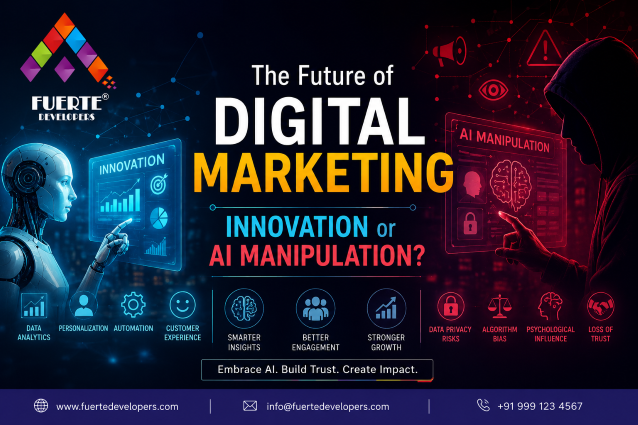
We now have access to AI created ads, hyper-personalized email marketing campaigns, automated chatbots, and predictive analytics, all of which can help us understand customer behavior better than ever before. However, as our digital marketing efforts become increasingly intelligent, one question continues to arise: Is artificial intelligence impacting and changing marketing through innovative changes, or is it manipulating consumers in ways we do not fully comprehend? The answer lies somewhere between these two ideas.
The Rise of AI in Digital Marketing
As businesses continue developing their marketing strategies through artificial intelligence, it is no longer a thing of the future; AI is already ingrained into the everyday practices and platforms available to businesses.
Search engines use AI algorithms to determine content rankings. Social media outlet algorithms decide what users will see; email services will use AI to determine when the best time to send an email campaign would be; e-commerce platforms will recommend products to consumers based on a combination of browsing activity, purchase history, and even some emotional factors.
Today, AI helps marketers:
- Analyze massive amounts of consumer data instantly
- Create personalized advertisements
- Automate customer support through chatbots
- Predict buying behavior
- Generate content, captions, and visuals
- Optimize ad campaigns in real time
- Improve targeting accuracy
For businesses, these marketing technologies generally mean improved efficiency, being smart and fast, reduced costs, and improved marketing execution. For consumers, they typically result in a more seamless and personalized experience while using electronic devices and/or shopping online. But there may be a dark side to this continued growth of the increasingly advanced technologies you see occurring.
When Personalization Becomes Manipulation
As we go on with technology and AI use, the difference between ‘helpful personalization’ and ‘psychological manipulation’ is becoming less obvious.
AI systems are built to create a profile based upon a user’s behavior. Each time an individual interacts online, the system collects the user’s data; e.g. interests, fears, habits, emotions and the way that they make decisions, etc.
These metrics allow marketers to create many campaign types targeting consumers to influence them through precise measurement for their buying decisions.
For instance,
- Social media sites begin to see how emotions affect engagement
- An AI campaign can change creative depending on how users behave
- The algorithms will sort the content to a point where the user will see what will result in the maximum amount of time looking at a screen
- Dynamic pricing could change due to how a user will behave or where they are located.
In many cases, users do not have an idea of how much AI has impacted their decisions when they purchase or their beliefs about what they see or buy online.
The concern is not just the automation of work, but also that AI may take advantage of our existing knowledge of how we are psychologically engineered to make money from that commonality.
The Power of Predictive Marketing
The use of predictive marketing is one of the strongest capabilities of artificial intelligence.
Predictive marketing uses historical data with machine learning technology to help businesses anticipate future buying habits of consumers, even before consumers make their own buying decisions.
For example, streaming services will recommend movies or shows that a viewer is likely to want to watch next. Online retailers can predetermine which products customers may require before they even begin searching for those products. Advertising networks can automatically identify the specific audiences that are most likely to respond to their advertising campaigns.
This type of predictive capability allows businesses to take advantage of many great opportunities. For example, by establishing better predictive capabilities, businesses should be able to reduce waste in their advertising expenditures and provide better customer service, as well as dramatically increase their sales.
However, predictive systems create a number of ethical concerns:
- Are consumers able to make independent decisions?
- How much influence should predictive algorithms have on consumers?
- Should businesses disclose the means in which they personalize the experience for customers?
These are becoming increasingly essential questions to ponder as AI systems continue to evolve and be utilized.
AI-Generated Content: Creativity or Content Saturation?
The marketing industry has completely changed in today’s age of technology thanks in part to AI content creation tools.
Now, brands can make:
- Blog Articles
- Product Descriptions
- Social Media Posts
- Emails and Email Newsletters
- Video Scripts
- Images and Ads Created by Computer
The power of AI Content Creation tools has enabled businesses to create so much content so quickly that, while they are trying to maximize efficiency, they have also created a flood of online content that is often devoid of originality, emotion, and true human insight. As more and more brands create content with AI, it is likely that consumers will begin valuing authenticity over perfection.
Today’s consumers are more likely to be attracted to authentic, transparent, and emotionally engaging brands than they are to brands that use only automated processes to produce their marketing communications. Brands that can successfully balance the use of automation with the power of authentic storytelling may be the ones that ultimately succeed in utilizing the power of AI to grow their business and brand in the future.
The Ethical Challenges of AI Marketing
As AI becomes more powerful, ethical concerns continue to grow.
Some of the main concerns are the following:
1. Privacy of Data
People give up their private information, often without realizing how it was gathered or what it may be used for. AI relies heavily on this data to operate correctly.
2. Deepfake Advertising
Voices, faces, and videos that are AI generated are becoming more realistic. Therefore, there is more possibility to create misleading advertising and false endorsements of a brand
3. Algorithmic Bias
AI systems are only as fair as the data they learn from. Poorly trained systems may unintentionally reinforce bias, discrimination, or misinformation.
4. Loss of Human Creativity
Many marketers increasingly rely on AI-driven marketing solutions for their campaigns, leading to some marketers becoming overly dependent on automated systems. Overdependence on automated systems diminishes the creativity and originality behind marketing campaigns.
5. Consumer Trust
If people feel manipulated rather than helped, trust in brands and digital platforms may decline significantly.
Businesses that ignore these ethical concerns risk damaging both their reputation and long-term customer relationships.
conclusion
AI is reshaping digital marketing in powerful ways, offering smarter targeting, automation, and personalized customer experiences. However, the future belongs to brands that balance innovation with ethics, transparency, and authentic human connection. In the age of AI, trust will matter more than ever.