


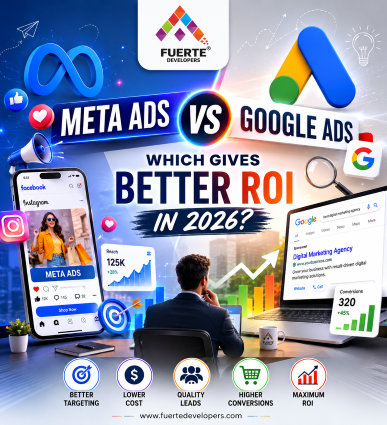
By 2026, the digital advertising industry has seen a drastic increase in automation, intelligence, and competitiveness. This has allowed companies to utilize many of these platforms, which are capable of producing leads, sales, and brand awareness at scale. The two leading platforms are Meta Ads and Google Ads.
For businesses and marketers, there is one big question they all want to ask: Which platform is going to provide them with the best ROI?
There isn’t just one answer to this question since both Meta Ads and Google Ads offer different advantages; therefore, they each provide different types of value along the customer journey. To make the best advertising decisions possible, you must understand how each of these two platforms operates to maximize your return on your advertising dollars.
What Are Meta Ads?
Meta’s advertising solution, which includes ads that run through Meta’s channels, like Facebook, Instagram, Messenger, and the extended Meta ad network, is based on the idea of reaching your customers when they are using social media, viewing content, or interacting with brands.
Unlike search-based advertising, where people often search for a product or service before seeing an ad, Meta’s advertising focuses on providing relevant ads through visual engagement and creating demand based on these visual stimuli.
This is particularly advantageous for businesses that rely on visual storytelling as a means of generating demand for their product or service before it exists. Many fashion brands, lifestyle-oriented businesses, and fitness companies, as well as some e-commerce sellers, tend to do particularly well using this medium so that they create demand for a product/service before they are ready to purchase the item.
By 2026, Meta will have increased its automation for optimizing an advertiser’s campaign by leveraging AI, including automated audience expansion, optimizing creative testing, and improved predictive targeting. As a result of these efficiencies, advertisers can have an overall less manual effort when identifying potential customers that are relevant to their respective brands.
What Are Google Ads?
Google Ads works differently from display advertisements since they show up based on a specific action taken when someone is looking for information, products, or services instead of appearing based on general online behavior and as a response to a search query, and therefore, when someone searches for something like “the best digital marketing agency” or “buy groceries online,” they have an immediate need, and they are also much further along in the purchase process than someone who is scrolling through their favorite social media feed.
Google Ads are also often very effective at generating high-quality leads for businesses that rely on converting leads at the time of the advertisement, such as healthcare clinics, SaaS (Software as a Service) companies, law firms, and local service providers.
In 2026, Google’s advanced machine-learning bidding technology and campaign-automating processes will have enabled better performance metrics, such as using Performance Max campaigns, Smart Bidding, and predictive models of conversion to yield higher efficiency and less manual optimization.
Comparing ROI: Where Does Each Platform Win?
When considering ROI, the main emphasis shouldn’t be just on cost per click. A lower CPC does not equate to higher profitability. In actuality, true ROI is obtained by measuring the revenue or business value created from each rupee or dollar of expenditure made.
Google Ads typically has a higher performance level when conversion intent is high, as users will have shown an active interest in purchasing. Businesses should see this as an opportunity for better quality leads and quicker conversions due to the active nature of users searching for products/services. Therefore, Google is best suited for campaigns where immediate sales or lead generation objectives are required.
Meta Ads are usually better suited for generating brand awareness and nurturing a future customer base. Even if they may not have any intention of purchasing immediately, repetitive exposures to captivating advertisements may have an effect on their decision to purchase in the future.
Cost is another consideration, as often Meta Ads tend to have less expensive traffic than Google Ads, particularly in heavily competitive industries where the bidding of keywords is much more expensive. Small to medium-sized organizations will find Meta more affordable to attain large-scale audiences compared to Google.
That said, lower cost does not necessarily guarantee better returns. If your audience does not have an intention to convert, less expensive traffic can still yield low or negative ROI.
Meta Ads: Where It Delivers Stronger ROI
When the objective is primarily to generate revenue, then advertising on Meta Ads tends to give good return on investment (ROI). Businesses that sell products that are visually stimulating will find this platform especially helpful as it enables them to create an emotional bond with potential buyers via the use of pictures, short video advertisements, and various types of interactive content.
Another strength of Meta is in the area of retargeting. When a user visits a product page and does not make a purchase, Meta provides a simple way to reach out and re-engage that user through customized advertising. These kinds of “reminder” campaigns typically have high conversion rates and low costs.
Meta is especially valuable for:
- Brand awareness
- E-commerce growth
- Retargeting campaigns
Google Ads: Where It Delivers Stronger ROI
When companies want to generate quick, high-intent conversions, Google Ads usually outperforms Facebook Ads. This is because search-based advertising places brands in front of potential customers who are actively seeking out solutions and are very likely ready to make a purchase.
As a result, businesses receive an overall higher volume of quality leads and a quicker turnaround time for making a decision.
For service-based businesses, this benefit can be even more pronounced. When someone searches for a dentist, accountant, or marketing consultant, they have an urgent need that needs to be filled. Therefore, this urgency will frequently result in a higher conversion rate.
Google is particularly effective for:
- Lead generation
- Local service businesses
- High-intent purchase searches
Which Platform Should You Choose in 2026?
Choosing between Meta Ads and Google Ads depends largely on your business objectives.
Choose Google Ads if you want:
- Fast lead generation
- High-intent traffic
- Better conversion rates
- Strong ROI for services or B2B
Choose Meta Ads if you want:
- Brand awareness
- Lower acquisition costs
- Scalable e-commerce sales
- Better retargeting opportunities
The Best Strategy: Use Both
In 2026, the combination of the two platforms produces the highest return on investment (ROI) versus a standalone platform.
A wise way for companies to advertise is through Meta Ads for creating brand awareness and generating demand and then through Google Ads to reach the highest intent of buyers who are ready to reveal their identities and spend money on purchases.
A typical high-performing funnel looks like this:
Step 1: Meta Ads introduces your brand to new audiences
Step 2: Prospects visit your website or engage with content
Step 3: They later search your brand or solution on Google
Step 4: Google Ads converts them into customers
This combination creates a full-funnel strategy that maximizes ROI.
Conclusion
When it comes to comparing Meta and Google advertising in 2026, it’s less about determining which one is superior and more about determining how to use them for their intended purposes.
Meta helps businesses generate demand, and Google helps companies capture demand. This is an important distinction to make when evaluating ROI. A platform will provide superior returns only if it is aligned with the appropriate business objective.
For many modern organizations, the best way to achieve superior ROI is through combining both platforms into one cohesive strategy. Using each of these platforms for their unique capabilities enables brands to increase awareness, engage an audience, and convert potential customers who are ready to purchase like never before.