



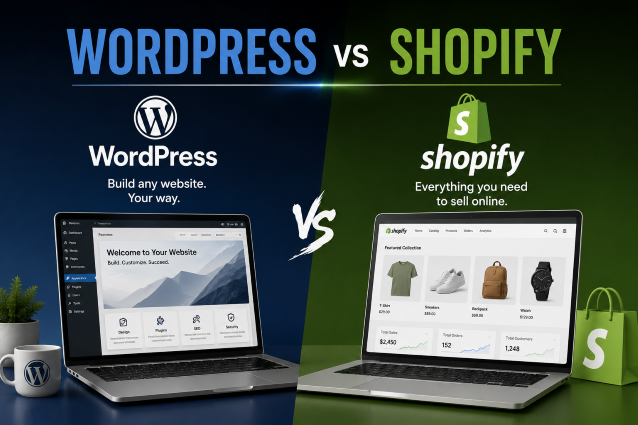
The selection of an appropriate platform for your website has a direct effect on how successful your business will be through both growth and sales as well as providing customers with a strong experience online. Presently, two excellent options available are WordPress and Shopify; both platforms are highly capable but can support different functionalities for businesses.
The Key Question to Ask Yourself:
Which Is A Better Fit For My Business, WordPress Vs Shopify?
The answer is based entirely on the type of website desired (i.e., a content site or an eCommerce site) along with how much control you need over your website.
In the following sections, we will evaluate the features offered by WordPress and Shopify, pricing through both platforms, flexibility of both platforms with respect to customization, SEO capability of their respective sites, and how easy each platform is to use. All of these factors combined will help you make an educated decision.
What Is WordPress?
Millions of websites are powered by WordPress around the world, making it the most used website platform today. An open-source content management system (CMS) that allows you to take complete control of your site, WordPress is an excellent choice for working on your site.
It is possible to build a variety of sites using WordPress, including:
- Business related websites
- Blogs
- Portfolio websites
- Membership Sites
- Stores
Benefits of WordPress
- Fully customizable
- Large selection of themes and plugins available
- Great for SEO
- Owner of all of the website data
- Can grow and change as your business grows
Disadvantages of WordPress
- Requires setting up a hosting plan and service
- More upkeep than other platforms
- How secure your site is based on the plugin you use and the updates done on your website
What Is Shopify?
Shopify is an eCommerce platform optimized for eCommerce with an automated infrastructure that allows you to run your eCommerce business successfully. It provides you with the technical infrastructure for running an online store (and much more), including web hosting, data security, payment processing, and performance optimization.
You can use Shopify for:
- Online stores
- D2C brands
- Product catalogs
- Multi-channel selling
- Dropshipping businesses
Advantages of Shopify
- Beginner-friendly
- Fast store setup
- Built-in payment options
- Secure hosting included
- Strong inventory management
Limitations of Shopify
- cost of monthly subscription
- not as flexible as WordPress
- advanced customization will require a developer’s help
WordPress vs Shopify: Key Comparison
1. Ease of Use
In terms of ease of use, Shopify has a clear advantage over other platforms like WordPress, especially when it comes to beginners. While WordPress has many powerful features and customization options, it requires a lot of time and effort to learn how to use them all effectively. You will need to manage your own hosting, install various plugins, update the software, and maintain your own website. If you are a beginner or do not have very much technical knowledge, this can be very difficult, and you may need to hire a developer for assistance. On the other hand, Shopify was built to make it as easy as possible for someone to set up an online store by using a simple, user-friendly dashboard and guided onboarding process. Most of the features that you need to run your online store have already been developed into Shopify’s platform, so you will not have to do much extra work to get started in eCommerce. Therefore, because of its ease of use and simple setup process, Shopify is the better option for anyone looking for ease of use when creating an online store.
2. Customization
When looking at customization between WordPress and Shopify, the winner is WordPress, due to the fact that it offers nearly limitless options for customizing many aspects of a business’s website, from the design and layout on the front end to functionality and advanced features on the back end. With literally thousands of theme options, plugins, or other custom development opportunities, any business can have a truly unique and customized presence on the Internet with WordPress. Shopify has its own methods of customizing via the use of themes or apps; however, they are limited to the platform. Although many businesses have no issues with the restrictions of using an e-commerce platform, the flexibility and options provided by WordPress may be the better option for businesses requiring a more extensive or unique level of customization and functionality.
3. E-commerce Features
When comparing e-commerce features, Shopify is clearly the winner since it was designed from the ground up solely for the purpose of selling online. As a result, it comes with several powerful built-in tools, including inventory management, shipping management, a payment gateway, abandoned cart recovery, and sophisticated sales reports. Using these tools, a business can efficiently manage its daily operations. However, compared to Shopify, a business using WordPress must use third-party plugins like WooCommerce and other solutions to establish an identical level of performance. Thus, while WordPress offers flexibility in the customization of an operation, building a fully functional e-commerce store on WordPress usually requires more configuration and management than with the complete solution provided with Shopify.
4. SEO Performance
Both WordPress and Shopify have great SEO capabilities; however, most SEO experts consider WordPress the most suitable platform for the purpose because of its ability to allow for advanced customization and provide more control over technical optimization. Unlike with Shopify, where basic SEO functionality is available and there are no means to control other technical components aside from using applications, users on WordPress have the ability to fully optimize URL structure, schema markup, metadata, technical settings, and more through powerful plugins and customizations. This level of customization allows users to implement more comprehensive SEO strategies based on their companies’ goals than they could implement using Shopify. Thus, users that require deep SEO customization and a commitment to long-term organic growth will find WordPress more suited to their needs than they would find it if they were to use Shopify.
5. Cost
When discussing the costs of WordPress vs Shopify, cost is a critical consideration. WordPress could turn out cheaper at the start; however, costs depend heavily on your specifications. A few of the main costs would be one-time and recurring domain registrations, web hosting, premium themes, plugins, and ongoing maintenance. Less complex sites would incur low costs, but advanced features could ramp up to substantial fees. Shopify’s pricing model is subscription-based, with predictable monthly costs, and it certainly includes transaction fees and additional charges for premium apps. While Shopify appears a tad expensive upfront, it offers bundled services, which ease planning and lessen the need for technical resources. The better option will depend significantly on the size of your business, available budget, and long-term goals.
6. Security & Maintenance
Compared to WordPress, Shopify provides a much easier time managing these aspects of your store’s daily operation. WordPress requires the user to update their software digitally to keep things in sync when plugins change. The user must also actively back up their store and implement all necessary security protocols to ensure their store’s continued operation. This requires continual monitoring and knowledge of technology. Shopify provides the majority of these services for you, including providing an SSL certificate, any security upgrades, web hosting maintenance, and optimizing your web server. By using this type of management, you can minimize the chance of technical problems so you can concentrate more on making sales and growing your business. If you are looking for an eCommerce platform with lower maintenance and stronger built-in security features, then Shopify is your best bet.
WordPress vs Shopify Comparison Table
| Feature | WordPress | Shopify |
| Ease of Use | Moderate | Easy |
| Customization | Excellent | Good |
| SEO | Excellent | Very Good |
| eCommerce | Good (WooCommerce) | Excellent |
| Security | Self-managed | Managed |
| Maintenance | Higher | Low |
WordPress is ideal if:
If you’re seeking total control, require strong SEO support, maintain a content-heavy site, desire custom features, or require large quantities of resources to grow your enterprise, WordPress is right for you.
Also, it’s perfect for:
- Agencies
- Businesses that provide services
- Bloggers.
- Real Estate (or large content) Sites.
Shopify is perfect if:
- Selling products is the most important part for you.
- Speedy setup is key for you.
- Management couldn’t be less technical for you.
- Built in eCommerce capabilities are necessary for you.
Who This is Best Suited For:
- Online Retailers
- Direct to Consumer (DTC) Brands
- Clothing and Apparel Stores
- Product Based Businesses.
Which Platform Is Better for Small Businesses?
Many small businesses want to know if they should pick flexibility or simplicity.
If your business relies heavily on content marketing and search engine rankings, then you usually should select WordPress.
If you just want an easy and reliable way to set up a physical store online with little to no technical issues to deal with (like Shopify), then selecting Shopify is usually the better option.
Multiple growing businesses use both options:
- To use WordPress for creating and implementing product pages and search engine optimized pages on those product pages.
- To use Shopify to sell products to customers.
Conclusion
Choose WordPress when you need to have maximum ability for customizing the website, controlling strong SEO, and acquiring flexibility long term. Choose Shopify when you are looking to build a fast and dependable eCommerce store, while at the same time making it easy to handle/manage the site.
There is no answer that is for everybody. The best platform will depend on your business goals and how comfortable you are with technology, as well as what type of growth strategy you want to use. The proper system will be one that supports your clients, adds convenience to the operation of the business, and helps your company grow online.