

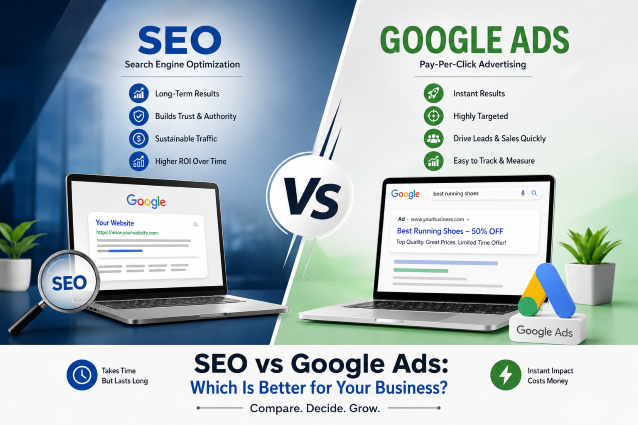
There are two basic ways to be found in Google searches through organic search (SEO) and paid advertisements (Google Ads), and both methods have benefits and drawbacks. The proper answer to which method is “better” depends on your objectives, budget, and timeline.
In this guide we will cover a breakdown of how SEO works, how much it costs, and how quickly you get results; we will also cover a breakdown of how Google Ads work, how much they cost, and how quickly you get results; and finally, we will provide criteria for selecting which tactic to use first.
What Is SEO?
SEO (search engine optimization) consists of making changes to your site to get your pages to rank higher for free (organic) results. For example, if you’re writing a blog post on the “best running shoes for flat feet” and your post ends up being on the first page of the results, you accomplished that through your use of SEO.
SEO can generally be broken down into 3 categories:
On-Page SEO – optimizes content, titles, headings, and internal links to make it easier for search engines to know what is on the page.
Technical SEO – the speed of the site, whether the site is mobile-friendly, crawlability, and structure of data are all factors that help google see the site correctly when indexing.
Off-Page SEO – creating backlinks and being mentioned on other sites builds authority and trust.
The principle stays the same, create useful content, make the site easy to use, make it easy for google to read, and develop authority over time.
What Is Google Ads?
Google Ads is a PPC platform for advertising on the Internet. You bid on keywords, draft your ads, and each time someone clicks, you pay. Your ads can be above the organic results on a search page, marked as “Sponsored,” and may appear across YouTube, Gmail, and millions of partner sites.
The best part is speed. You can launch a campaign today and start getting targeted visitors in a few hours. Additionally, control over the audience who views your ads is precise, using keywords, location, device, time of day, and audience.
The downside: Stop paying, and the traffic stops.
SEO vs Google Ads Comparison Table
| Factor | SEO | Google Ads |
| Speed to results | 3–12 months | Hours to days |
| Cost model | Upfront investment, low ongoing cost per visit | Pay per click, ongoing |
| Traffic longevity | Compounds and lasts | Stops when budget stops |
| Click-through trust | Higher (users trust organic) | Lower (users know it’s an ad) |
| Control over targeting | Limited | Precise and granular |
| Best for | Long-term growth | Fast results and testing |
Cost: What You’ll Actually Spend
SEO prices are fronted this way: content creation, technical work on the back end, and link building. This could be done by a freelancer, an agency, or, with your time investment already calculated. Of course, once the page ranks, each subsequent visit practically costs you nothing. After a year or two, its price might drop far below that of paid advertising.
Google Ads are ongoing costs dependent on your industry. Cost per click can be from less than a dollar in less-competitive markets to over $50 in the legal service or insurance industry. You are going to pay for every single click, every single day, as long as you want that traffic.
A good way to think about it is that SEO is like buying a house, whereas Google Ads are like renting. One is an asset; the other is about flexibility and instant access.
Speed: How Fast Do You See Results?
The way each method produces results differs significantly. In terms of immediacy, Google Ads offers you quick access to potential customers. When you create a Google Ads campaign, once funded, visitors can be sent to your website the same day you create the campaign. This is perfect for launching new products, seasonal sales, and finding out if there is demand for what you are selling.
SEO is a process that takes time to see results. Depending on how competitive your market is, new websites may take anywhere from six to twelve months before they begin to see results. However, the traffic generated through SEO tends to be long-lasting and builds over time as a brand builds its authority and recognition. Because of this, SEO will likely become your most cost-effective channel over time.
Trust and Click-Through Rates
Many users inherently advance through a set of advertisements to a set of organic listings as a result of the common belief that organic listings are the most credible. If your brand shows in an organic placement, it presents an air of authority that cannot be matched with advertisement placements in all situations.
However, advertisements are being targeted with ever-increasing precision, and ad copy is improving to such an extent that high intent searchers often click an advertisement without hesitation. As such, for bottom of funnel, transactional searches, advertisements convert at a very high rate.
When SEO Is the Better Choice
When you want to use SEO as your winning strategy:
If you’re developing your brand for the long term and can wait for a return on investment. If your customers perform research before making a purchase, educational content will build their trust.
High-value, evergreen topics exist that consumers continue to search for regularly.
You have thin margins and cannot afford to spend money on advertising on an ongoing basis.
When Google Ads Is the Better Choice
Google Ads will often have an advantage when:
- You’re looking for immediate leads or sales (rather than waiting 6 months)
- You are launching a new product and want very fast market feedback
- You are promoting something time-sensitive or seasonal
- You are targeting high intent keywords where a clicked will generate revenue
- You have little or no organic ranking for the highest priority keywords.
The Smartest Strategy: Use Both Together
SEO and Google Ads are not competitors but complementary in most cases for businesses of any size that want to continue to grow into the future. With Google Ads, you can capitalize on immediate demand while your SEO initiatives develop momentum behind the scenes. Furthermore, by utilizing your Google Ads keyword data, you can be sure that the terms you are targeting for SEO are already proven to convert, allowing you to create high-quality SEO content based on that outstanding keyword performance. Once your organic rankings are well established, you can downsize your ad spend associated with the terms you are now ranking for organically and repurpose those funds for new opportunities.
Overall, by merging these two tactics together, you get the opportunity for immediate results today and the chance to sustain those results into the future.
How to Decide Right Now
Consider three questions before deciding between SEO or Paid Ads:
1) How quick do I want results?
Urgent = paid ads; patient = SEO
2) What’s my budget?
Limited cash flow favors the long-term efficiency of SEO; cash on hand favors the short-term victory of ads.
3) What’s my goal?
Building a long-lasting asset favors SEO, while testing offers/driving sales favors PPC.
If you can only utilize one channel initially, select the channel that meets your greatest need first; then as you gain momentum, add the additional channel.
Conclusion
There is no general agreement on whether or not SEO is superior to Google Ads. While Optimizing For Search Engine Traffic (SEO) produces sustainable, cost-effective results, it does require time before rewards show up. Google Ads provides immediate visibility and specific visitors to your business; however, when you turn off Google Ads, you stop receiving visitors immediately. Your choice will vary according to your timeline, budget, and objectives, but generally speaking, successful companies take advantage of both techniques simultaneously, using paid advertising as a catalyst for attracting and acquiring new customers rapidly while at the same time developing an SEO strategy that provides them with long-term benefits as well.