


The power of local SEO & hyperlocal targeting is more important than ever in today’s highly connected world. If you are a small business owner who wants to get more customers in your area or an enterprise existing as a large company who only wants your business to succeed mainly in a particular neighborhood, learning about and using local SEO & hyperlocal targeting will increase how well you are found online significantly.
This guide contains all the information you will require to dominate local search in 2026, specifically detailing all aspects from basic to expert level strategies.
What is Local SEO?
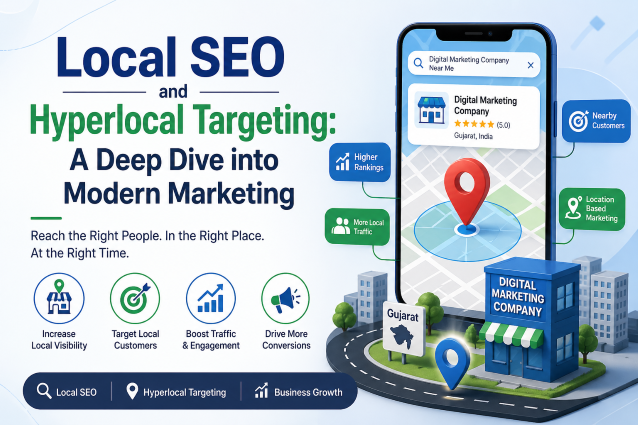
Local Search Engine Optimization (SEO) is the process of enhancing your presence online so that your business can surface in results for searches performed in location-specific areas. In most cases, these types of searches consist of users searching for products or services to purchase or obtain within geographical boundaries of cities, neighborhoods, and/or areas characterized as “near me.”
Example—When someone types “Best Digital Marketing Company in Rajkot” or “Super Mart Near Me,” Google Search will display a list of local businesses relevant to the search term, along with a map, reviews, and contact information for each business, much of which is provided by Google Business Profile, among other sources.
As such, Local SEO places your business in front of potential customers at the moment those customers are looking for you and is therefore an effective technique to deliver results that lead to opportunities to create sales or otherwise generate revenue for your company.
Why is Local SEO Important?
Local SEO is very important for any company trying to have visibility in the local area.
Local visibility: So why is it a priority?
- Increased Foot Traffic and Sales: Because it will make sure that your business comes up when somebody near you searches for what you provide. This will increase how frequently a customer visits your store or purchases from you.
- Targeting Highly Relevant Audience: This is a very targeted way to reach your customer, as you are targeting only users who are searching for your products or services in their local area. This makes local SEO more successful than traditional or broader style searches (general SEO).
- Mobile Usage: With the use of smartphones in the marketplace today, local search is becoming even more critical. According to Google, 3 in 4 local searches result in that person visiting their business within a day, while also leading to a purchase in 28% of those cases.
- Competitive Advantage: Still, many local companies have not made local search a priority. Making local search a priority gives you a significant edge over your competitors.
- Improved Brand Trust: Finally, being found in local searches (and especially in the “maps” section) builds trust and credibility with persons searching for your business and creates more clicks to your business.
The key components of Local SEO
To be successful with local SEO you need to put your effort into a few key areas.
1. Google Business Profile Optimization
Your Google Business Profile acts as your digital storefront.
Best practices include:
- Claim/verify your Google listing
- Have your name, address and phone number (NAP) be identical
- Add various business categories, products and images
- Get reviews from your customers and reply to them
- Post consistent updates, promotions and announcements
2. Local Citations/NAP Consistency
Citations are any contact information found in directories or websites regarding your business.
To do well with references, you should:
- Have an identical name, address and phone number (NAP) at all times
- List your business in credible platforms, i.e. Justdial, Sulekha, etc.
- Keep your NAP the same at all times. A discrepancy can have a negative effect on how you rank.
3. Optimize for Local Keywords
Local Keywords are any keywords that relate to your physical location.
Some examples of local keywords are “Supermart in Rajkot.” “Health Care near Me.” To do this, you can:
- Use tools to identify high-volume local keywords
- Place keywords naturally in your titles, headings and content throughout your website
- Create pages and/or blog content that focuses on the metro areas you are trying to reach.
4. Mobile Optimization
The vast majority of all local searches occur on mobile devices. Therefore, your website needs to:
- Load extremely fast
- Be usable on every single device type
- Provide a seamless user experience.
Additionally, you should utilize structured data (schema markup) so that search engines better understand the details of your business.
5. Local Backlinks
Using backlinks from local sources can enhance your credibility and authority. There are several ways to create these types of links. They include:
- Working with other local businesses or events.
- Guest blogging for other local blogs.
- Getting covered by local news outlets and/or directories.
What is Hyperlocal Targeting?
Although local SEO covers a larger area, hyperlocal SEO covers a much smaller area. Whereas local search engine optimization targets customers throughout a city or region, hyperlocal targeting is far more targeted and focuses only on customers in a particular neighborhood, street, or block. This type of marketing is exceptionally valuable to businesses that have a customer base that is highly localized or that rely on customers from a small geographical area, such as Bekery shops, boutiques, or service providers like plumbers or electricians.
With hyperlocal targeting, companies can greatly enhance their marketing strategies to appeal to very specific user behaviors.
For example, a bakery shop may use hyperlocal targeting to direct its marketing efforts to consumers who live within a two-mile radius of their business, thereby maximizing their ability to convert ads and search results into people who physically come to buy from the Bakery shop.
Enhancing Local SEO through Hyperlocal Targeting
- Customized Marketing Efforts
By utilizing hyperlocal targeting within marketing efforts, businesses can create offers, content, and messages targeted specifically to communities or neighborhoods.
- Increased Conversion Rates
Because hyperlocal audiences are physically close to your company, they’re more likely to respond to your marketing efforts.
- Enhanced Data Intelligence
Using hyperlocal targeting will provide you with valuable insight into local customer behaviors and help you define your overall marketing strategy.
- Enhancing Engagement
Focusing on a narrower area will create more engagement opportunities for local audiences as well as build a stronger connection.
How to Successfully Use Hyperlocal Targeting
- Enhance Content with “Near Me” Keywords
Use natural, geo-specific keywords in all website copy, including each listing.
- Utilize Social Media for Local Presence
Use Instagram and Facebook to specifically target local users within a certain distance from your business.
- Utilize Your Reviews and Testimonials
By having numerous positive reviews, it builds trust and thus allows businesses to rank and strength their local and hyperlocal presence within a given area.
- Utilize Geo-Targeted Advertising
Advertising on Google Ads can allow for targeted advertisements to users within a certain radius of your business.
- Participate in Local Events
When a business sponsors or hosts an event, the business gains exposure, builds trust in the community, and receives excellent, local backlinks.
Conclusion
With the digital space becoming increasingly competitive, Local SEO, and hyperlocal targeting are mandatory strategies for your business.
With a focus on optimizing your business across platforms such as Google, maintaining consistent business information, targeting location-based keywords, and connecting with your local audiences, you can greatly increase both visibility and conversions for your business.
Hyperlocal strategies go one step further by connecting your business with the right people at the right time in the correct location.
The businesses that succeed in 2026 will not just have an online presence; they will also have presence in their communities through a digital footprint that connects consumers with businesses immediately and meaningfully.