



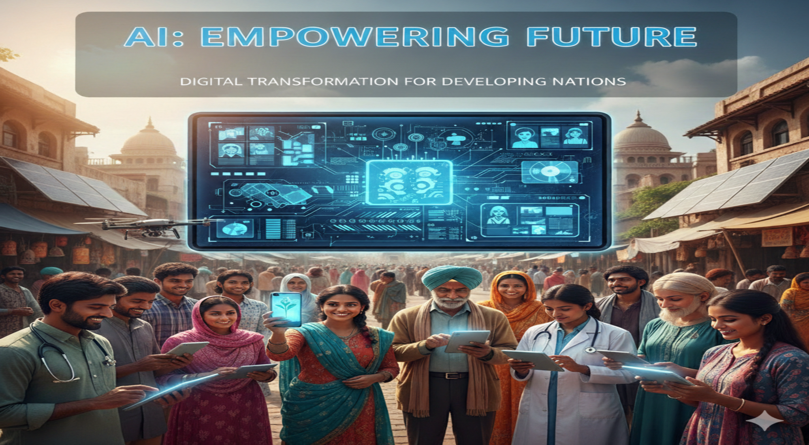
AI as a Game-Changer for Developing Countries
For ages, it’s been hard for developing countries to keep up with tech because they didn’t have the stuff they needed, things were too pricey, and folks didn’t have the right skills. Today, artificial intelligence is changing the digital world for developing countries in ways that were once unimaginable.
AI is no longer confined to Silicon Valley or global tech giants. With cloud platforms, cheaper gadgets, and tools that everyone can use, AI is now available to new businesses, governments, freelancers, and communities in Africa, Asia, and Latin America. Instead of making the gap wider, AI is actually closing it.
This blog is all about how AI is changing the digital world in developing countries in education, healthcare, jobs, how governments work, and new businesses.
AI and Digital Transformation in Developing Countries
Digital transformation in developing nations traditionally moved at a slower pace. AI has accelerated this transformation by removing long-standing barriers.
- Easier to Get Started Cloud AI tools mean you don’t need to spend big bucks on equipment.
- Innovation Happens Fast AI lets you test and get digital things out there quickly.
- Big Impact One AI thing can service millions without costing too much.
Because of this, developing countries can jump ahead instead of taking the slow road to get better.
AI in Education: More Access, Better Quality
Education is a super important area where AI is changing the game for developing countries.
- Learning Made Personal AI learning stuff changes what it shows you based on how fast you learn and what language you speak.
- People in remote areas can now access quality digital learning through AI assistants and educational apps.
- AI-driven learning focuses on practical skills such as coding, data analysis, and digital marketing.
Impact:
Millions of learners gain access to education that was previously unavailable or unaffordable.
AI in Healthcare: Saving Lives with Smart Tech
Healthcare in developing countries often doesn’t have enough workers or stuff. AI is helping fix that.
- Early Detection—AI can look at medical images and patient info to spot diseases sooner.
- Telemedicine & AI Assistants—Chatbots and telehealth give patients advice and diagnoses.
- Data-Driven Public Health—Governments use AI to follow disease outbreaks and make the best use of healthcare.
Result:
Improved healthcare outcomes with lower costs and wider reach.
AI and Jobs in Developing Nations
People worry AI will take all the jobs, but in many countries. it’s not that bad.
- New Digital Jobs
AI is creating a need for:
- Sorting data
- Teaching AI
- Checking content
- Online services
- Chance to Work Globally
People who freelance in growing countries can now work for clients all over the world because of AI tools.
- More People Starting Businesses
AI makes it cheaper to start a business, so people in local areas can start online businesses.
AI isn’t really taking away work. It’s changing it.
AI in Agriculture: Helping Farmers with Tech
Farming is still very important in many growing countries.
- Smart Farming–AI looks at soil info, weather, and how healthy crops are.
- Mobile AI Tools—Farmers receive real time advice on irrigation, fertilizers, and pest control.
- More Crops, Less Waste—AI predictions help stop crops from failing and reduce waste.
This tech change helps farmers earn more and makes sure there’s enough food.
AI and Financial Inclusion in Developing Countries
Millions of people in developing nations remain unbanked. AI is driving financial inclusion.
- AI in Financial Tech
AI helps with:
- Giving credit scores without old-fashioned bank info
- Spotting scams
- Financial help on your phone
- Getting Loans & Insurance
Now, even small businesses and everyday people can get loans and other things that used to be out of reach.
AI is helping to build trust in the money world, making things simpler, and letting more people take part in the economy.
AI in Governance and Public Services
Governments in poorer countries use AI to be more open and work better.
- Smart Government—AI makes public services automatic, cutting down on dishonesty and waiting.
- Digital ID & Services—AI helps with online ID systems and citizen info.
- Policy Decisions Based on Data—Governments are using AI to plan better and decide where to put resources.
This makes governments more helpful and responsible.
Challenges of AI Adoption in Developing Countries
Even though it can help a lot, using AI has its problems.
- Not Enough Infrastructure—Not having the internet and power makes things hard in the country.
- Skill Shortages—We are still learning about AI and tech.
- Ethical & Bias Concerns—AI systems that are taught using worldwide info might not fit local situations.
To fix these problems, we need support from leaders, schooling, and careful AI growth.
How Developing Countries Can Use AI Responsibly
To get the most out of it, using AI needs to be smart.
- Teach Digital Skills—Build AI skills from school to work.
- Help Local AI Grow—Support new companies that fix local problems with AI.
- Make Moral AI Rules—Make sure things are open, fair, and data is safe.
Using AI responsibly makes sure there is long-term, equal growth.
AI is reshaping the digital world, and Fuerte Developers is leading the change with smart digital services designed for developing countries. Contact us to grow digitally:https://fuertedevelopers.in/marketing/