


In the business world today it is very important to understand your customers. Understanding your customers is not about looking at what they did in the past. It is about knowing what they will need in the future. Imagine if you knew which people visiting your website were most likely to buy something from you before they even put anything in their cart. Imagine if you knew exactly when one of your long time customers was about to stop doing business with you. This is not something that’s impossible to know. This is what predictive marketing is. Predictive marketing is changing the way businesses work with their customers.
As a business owner or a marketing professional, you can use marketing to change the way you do things. You can go from reacting to things that happen to being proactive and making things happen. This can lead to your customers being happier using your resources in a way and making more money. If you have been wondering what predictive marketing is and how your business can use it, you are in the right place. This guide is for people who are just starting to learn about marketing. It will tell you everything you need to know about this way of doing marketing.
What Is Predictive Marketing?
At the heart of marketing is a strategy that looks ahead. It uses data, statistical methods, and machine learning to guess what will happen next and how consumers will behave.
Predictive marketing is about using data to make decisions. It does not rely on guesses. Just looking at past results. Instead it tries to figure out what is likely to happen
Imagine having a tool that helps you plan your marketing efforts. This tool uses a lot of data and advanced analysis to make predictions. Predictive marketing tools gather data from places.
These places include:
- Customer management systems
- Website data
- Transaction history
- Social media
- Email engagement
By looking at this data, predictive marketing tools find patterns and trends. These patterns and trends help marketers make decisions.
They can use this information to:
- Score leads
- Create content
- Develop products
- Allocate budgets
For example, predictive marketing might find that people who buy certain outdoor gear in the winter often buy camping equipment in the spring.
With this information a business can launch a targeted camping campaign in the spring. The business can aim this campaign at people who’re likely to be interested. They do not send a message to everyone. Predictive marketing helps businesses target their audience. It uses data to make marketing efforts more effective.
Why Predictive Marketing Matters Today
The importance of marketing has grown a lot in the last few years, and there are good reasons for this.
- The Data Deluge: Companies are getting more information about customers than ever before. Every time someone clicks. Buying something online creates a lot of data. This data is only useful if we can make sense of it. Predictive marketing gives us the tools to turn all this data into information we can actually use.
- Hyper-Personalization as an Expectation: Customers now expect a lot from marketing. They do not want to see the messages as everyone else does. They want companies to know what they like and what they need and to send them messages that are just right for them. Just using someone’s name is not enough anymore. Predictive marketing lets companies send messages, suggest products, and make offers that really mean something to each person.
- Increased Competition for Attention: There are so many companies trying to get our attention online that it is hard to stand out. To be seen, companies need to be creative. Send the right message to the right person at the right time. Predictive marketing helps companies do this and gets people to engage more.
- Advancements in Technology: Technology has also gotten a lot better. We can now use math and computer programs to understand data without needing a lot of money. This means that all companies, not just big ones, can use predictive marketing.
So predictive marketing is not something that would be nice to have it is something that companies need to do to stay competitive. Companies need to use marketing to understand their customers and to stay ahead in the market. Predictive marketing is very important for companies that want to be successful.
How Predictive Marketing Works
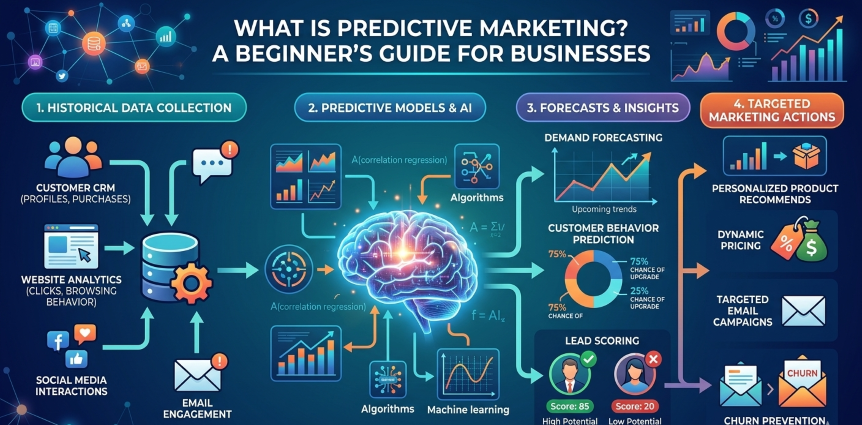
To make marketing work, you have to follow some steps. Here is what you do:
1. Define Objectives and Data Collection: Figure out what you want to do and get the data. You have to know what problem you are trying to solve. Do you want to keep customers from leaving? Do you want to sell stuff? Once you know what you want, you have to get the data from everywhere in your company. This data has to be clean and organized.
2. Data Modeling and Analysis: This is the part. You use math and machine learning to find patterns in the data. You can use things like the following:
- Regression Analysis: Looking at how things are related, like how much you spend on ads and how much you sell.
- Propensity Models: Figuring out how likely someone is to do something like buy something or leave.
- Cluster Analysis (or Segmentation): Grouping people together based on what they do or what they like.
3. Generating Predictions and Insights: The models you make will give you ideas about what will happen. For example, it might say which customers are most likely to buy something so your sales team knows who to talk to. It might say what products to offer to each group of customers.
4. Implementation and Optimization: Marketers use these predictions across their channels. This might mean creating email campaigns for groups adjusting online ads or personalizing website content. Predictive marketing is a process. As you get data from live campaigns, you analyze it, refine your models, and make them more accurate over time, leading to better results.
Real-World Applications of Predictive Marketing
Predictive marketing is not an idea; it is being used by businesses in many industries to get real results. Here are some key ways it is being used:
- Predictive Lead Scoring: Instead of just looking at things like company size or job title, businesses can score leads based on their behavior. This helps find out which leads are most likely to become customers. The sales team can then focus on those leads.
- Customer Lifetime Value (CLV) Prediction: Businesses can figure out which customers are likely to spend money over time. This helps them focus on building relationships with those customers, creating loyalty programs, and spending the amount on getting new customers.
- Product Recommendations and Upselling/Cross-selling: Online stores use marketing to suggest products to customers based on what they have bought before and what other people, like them, have bought. This helps increase the amount customers spend.
- Proactive Churn Management: Stopping customers from leaving is a deal. We need to find out which customers are at risk of canceling their subscriptions or stopping their purchases before they actually do it. We can use tools to look at things like how often they use our service if they are not using it as much as they used to or if they are contacting our support team in a certain way. When we see these signs, we can do something about it. We can offer them a deal or get in touch with them in a way that is just for them to try and keep them as customers.
- Dynamic and Personalized Content: We can also use these tools to figure out what kind of content our customers like to see. It is not about suggesting products they might like. We can look at what they have done in the past and use that to decide which blog posts, articles, videos, or stories about customers are most likely to make them want to buy something from us. We want to show them the things that will make them move to the step and become our customer.
Predictive Marketing vs. Traditional Marketing
Understanding the distinction between predictive and traditional approaches is crucial:
| Feature | Traditional Marketing | Predictive Marketing |
| Foundation | Relies on historical data analysis (Descriptive Analytics), gut feeling, intuition, and industry benchmarks. | Relies on historical data, statistical modeling, and machine learning (Predictive Analytics) to forecast future trends. |
| Focus | Reactive: Analyzing past performance to understand what worked or didn’t. Tends to be “what happened.” | Proactive: Focusing on future customer behavior and market shifts. Tends to be “what will happen.” |
| Customer Approach | Broad segmentation (e.g., Demographics like age, location) and generic messaging. | Hyper-Personalization based on individual behavior, preference, and calculated future needs. |
| Decision Making | Can be subjective; influenced by experience or biases. | Highly data-driven and objective, derived from complex model outputs. |
| Goal | Increase awareness; drive sales; measure ROI retrospectively. | Anticipate need; optimize engagement; maximize lifetime value; allocate resources efficiently before action is taken. |
While traditional marketing forms the necessary foundation, predictive marketing adds a crucial layer of foresight, transforming marketing from a backward-looking function to a powerful engine for anticipating and shaping future demand.
Benefits for Growing Businesses
For growing businesses predictive marketing is really useful because it helps them compete with companies. Here are some key benefits of marketing for growing businesses:
- Improved Return on Investment: When growing businesses focus their marketing efforts and money on the right people, they can save a lot of money and get more out of every dollar they spend on predictive marketing.
- Better Customer Experience and Loyalty: When growing businesses send messages and offers that are really relevant and timely, customers are happier and feel like the company understands them. This helps growing businesses build relationships with their customers, get them more engaged, and keep them loyal to the company in the long term with predictive marketing.
- Efficient Marketing: Predictive marketing does a lot of the hard work for growing businesses so their marketing teams do not have to spend so much time analyzing data with predictive marketing. This means they can focus on important things like coming up with new ideas, making campaigns better, and working on high-impact projects with predictive marketing.
- Better Demand and Inventory Planning: Predictive marketing is not just about what customers do. Growing businesses can also use it to figure out how much of a product they will need, which helps them manage their inventory and plan better with marketing.
- Faster and Smarter Decision-Making: When growing businesses use data to make decisions, they can make them faster. Feel more confident about them with predictive marketing. This is really important when things are moving fast and growing businesses need to make decisions with predictive marketing.
Predictive marketing for growing businesses might seem hard to understand at first. Once you know what it is all about, it is really useful for any business that wants to grow. You can start small with marketing, like by using it to score leads or make product recommendations, and see how it can really change the way your business does things today with predictive marketing.
Conclusion
Predictive marketing is a change from reacting to things after they happen to figuring out what will happen next. It helps businesses know what customers will do before they even do it. This way businesses can meet customers where they are. For businesses that are growing, it’s clear that data isn’t about what happened before. It’s a plan for whats going to happen. You don’t need a budget to use these tools, but you do need to make decisions based on data. When you use insights, you stop making guesses and start growing in a smart way.
The future of marketing is about being the voice that matters most, not the loudest one. It’s about being relevant to your customers. Predictive marketing helps you do that. It helps you understand your customers better and meet their needs before they even ask.