


If you’re running ads today, chances are you’ve faced this exact dilemma. Do you spend your budget on clean, perfectly lit studio ads that look premium and “brand-approved”? Or do you go all in on UGC ads, the slightly messy, phone-shot videos that look like real people talking to real people?
Scroll through Instagram, YouTube, or Facebook for five minutes and you’ll see both. One looks like a commercial. The other looks like content. And that difference alone has completely changed how advertising works in 2026.
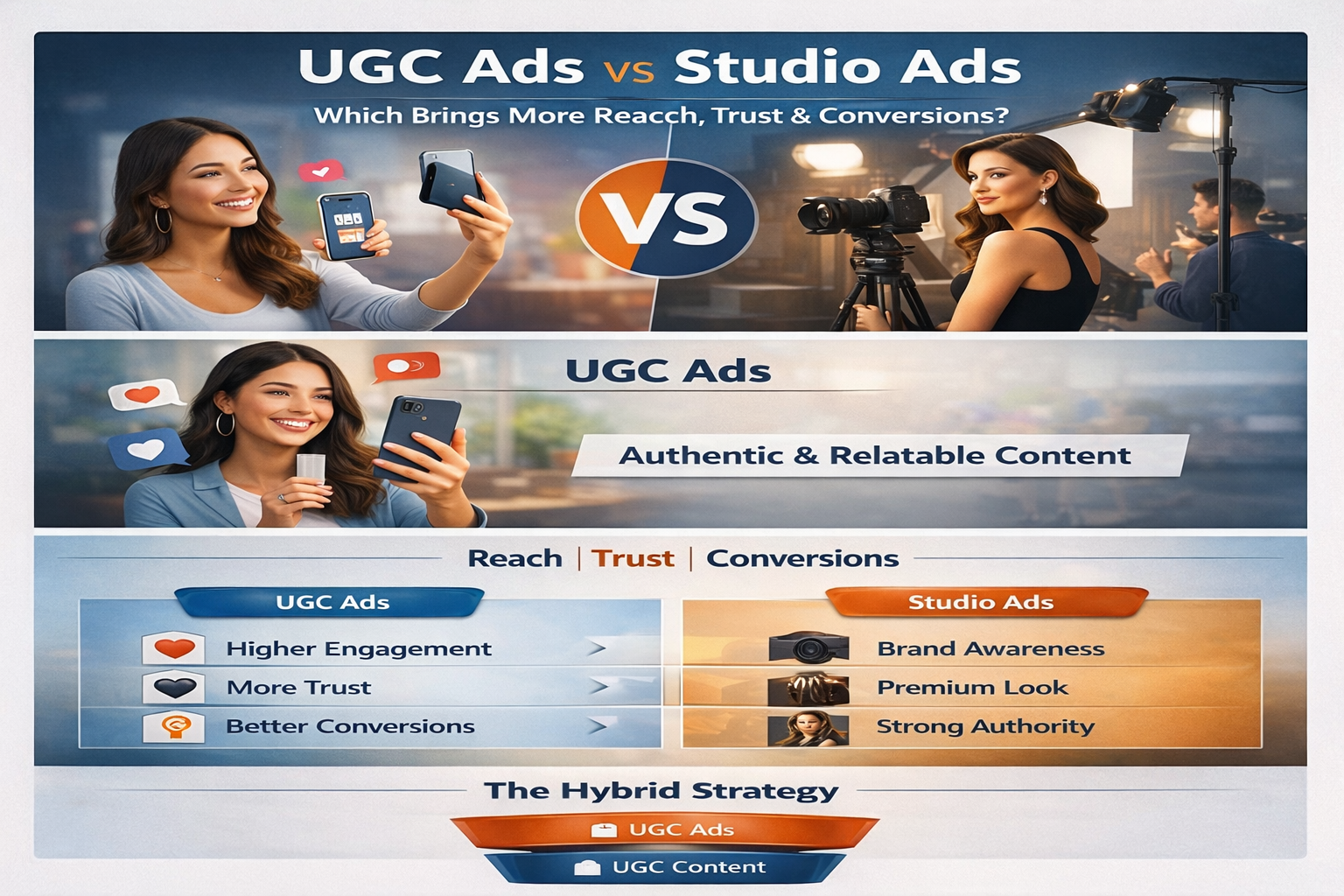
So let’s answer the real question, without marketing jargon or hype: Which actually works better when it comes to reach, trust, and conversions: UGC ads or studio ads?
What exactly are UGC ads?
UGC ads are designed to feel human. They don’t look like ads at first glance, and that’s the whole point.
These are the videos where someone’s sitting on their couch, holding a product, saying something like, “Okay, I didn’t expect this to work, but…” They’re often shot on a phone, in natural lighting, sometimes even with background noise. And strangely enough, that’s what makes them powerful.
UGC ads can be created by actual customers, creators, or influencers. Even when brands pay for them, the content is intentionally kept raw and relatable. No heavy scripts. No perfect angles. Just a person explaining their experience.
People don’t watch UGC ads thinking, “This brand is trying to sell me something.”
They watch, thinking, “Oh, this person sounds like me.”
What are studio ads?
Studio ads are the classic version of advertising most of us grew up with. They’re filmed in controlled environments, with professional cameras, lighting setups, styled models, and carefully written scripts. Everything is intentional, from the background color to the tone of voice.
Studio ads are about consistency and control. Brands know exactly how they’ll look, how they’ll sound, and how they want to be perceived. This is why luxury brands, enterprise companies, and legacy businesses still rely heavily on studio-style advertising. Studio ads don’t try to blend in. They want to stand out.
Let’s talk about reach: which one gets seen more?
This is where the gap starts to appear.
On social media platforms, UGC ads usually get more reach. Not because they’re “better” in a traditional sense, but because they behave like native content. Algorithms reward content that keeps people watching, engaging, and scrolling less.
When a UGC ad shows up in someone’s feed, it doesn’t immediately scream “advertisement.” People pause. They watch. Sometimes they even forget it’s an ad at all.
Studio ads, on the other hand, are instantly recognizable. Perfect lighting, polished visuals, and brand logos—it’s obvious. And once people recognize something as an ad, their instinct is often to skip it.
That doesn’t mean studio ads can’t get reach. They still perform well on platforms like YouTube pre-roll, OTT platforms, and large awareness campaigns. But on social feeds, especially short-form video, UGC ads almost always have the edge.
If your goal is purely to get in front of more eyeballs with less spend, UGC ads usually win.
What about trust? This is where things get interesting
Trust is the real currency of modern advertising. And this is where UGC ads truly shine. People trust people. Not brands.
When someone mentions a product in a casual way—maybe sharing a small issue or how they use it. it feels authentic. Even if viewers realize it’s an ad, it comes across as more credible than a polished, scripted commercial.
Ads made by users do something cool: they show people trust your brand. Viewers think, If it was good for them, I might like it too.
Ads from studios build a different kind of trust, based on authority and being professional. When done right, a brand seems solid, reliable, and serious.
But for normal, everyday buys like skincare, clothing, apps, or gadgets, user-made ads often feel more real. Being real builds trust faster than being perfect.
The big question: which one actually converts better?
If we’re being completely honest, UGC ads usually convert better for performance marketing.
Why? Because they don’t feel like someone is trying to sell them something. They feel like a recommendation. And recommendations convert.
UGC ads naturally answer objections. Someone might say how they were skeptical at first, or how long it took to see results, or who the product is actually for. These small details reduce friction and help people make decisions faster.
Studio ads can convert too, but usually in different scenarios. They work well for high-ticket items, premium brands, or when people already know the brand. They’re also powerful in retargeting, where the audience has already seen UGC or organic content and needs a final push.
In most direct-response campaigns, though, UGC ads tend to deliver higher click-through rates and lower acquisition costs.
Cost matters more than brands like to admit
Another big difference between UGC ads and studio ads is production cost.
- UGC ads are relatively affordable. You can work with multiple creators, test different hooks, and produce a large volume of content quickly. If something doesn’t work, you move on. No emotional attachment. No massive sunk cost.
- Studio ads are expensive. They require planning, crews, locations, editing, approvals, and time. That doesn’t make them bad, but it does make them harder to experiment with. When a studio ad underperforms, it hurts more.
For brands that want to test, learn, and scale fast, UGC ads offer far more flexibility.
Brand Building vs Performance Marketing
this is where most brands get confused
One common mistake brands make is thinking they must choose one format forever.
In reality, UGC ads and studio ads serve different purposes. Here’s where things get interesting.
| Goal | Best Choice |
| Brand Awareness | Studio Ads |
| Performance & Sales | UGC Ads |
| Trust Building | UGC Ads |
| Premium Brand Image | Studio Ads |
| Social Media Growth | UGC Ads |
| Long-Term Identity | Studio Ads |
The hybrid approach is where the magic happens
Many top-performing brands today use UGC ads to attract and convert new customers, then reinforce their credibility with studio ads later in the funnel.
Someone might first see a casual UGC video talking about a product. Later, they’re retargeted with a beautifully shot studio ad that tells the brand story. Together, these two formats build both trust and authority.
It’s not UGC versus studio anymore. It’s UGC plus studio.
Which Should You Choose?
Ask yourself:
- Are you running performance ads? → UGC
- Are you building a premium brand? → Studio
- Do you want faster conversions? → UGC
- Do you want long-term brand recall? → Studio
If budget allows, use both strategically.
Key Insights for 2026
- UGC grabs you right away. Since it looks like a post from someone you know, you probably won’t skip it.
- It’s cheap: UGC usually costs way less to make. This means companies can try out lots of different ideas without spending a ton of money on one fancy video.
- The Hybrid Approach: The most successful 2026 campaigns use Studio Ads for top-of-funnel awareness (to look established) and UGC for retargeting (to close the sale with social proof).
Pro Tip: In 2026, “Lo-Fi” is a high-performance strategy. Don’t over edit your UGC; the more it looks like a genuine iPhone recording, the better it usually performs.
Final thoughts
Advertising has changed because people have changed. Audiences today are smarter, more skeptical, and more allergic to anything that feels forced or fake.
UGC ads work because they feel human. Studio ads work because they feel intentional. The brands that win aren’t choosing sides. They’re choosing balance.
If you want more information about UGC Ads and Studio Ads, visit this site:
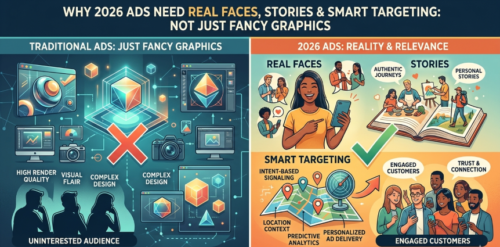
Why UGC-Style Ads Are the New Performance Marketing Formula
How Creativity, UGC, and Smart Targeting Are Driving 3X ROAS