


If I told you that the digital marketing trends for 2026 would be something so significant that they would create a major shift from what we saw in 2020, or perhaps 2024, would you believe me? This isn’t just an exaggeration. It’s true 2026 is already shaping up to be a major change for marketers.
As technology and customer behavior continue to change, new technologies that impact the way we engage with customers are being created and rolled out faster than before. For brands to survive, they must adapt to these new methods of customer engagement otherwise, they risk going extinct altogether.
In 2026 where AI assistants will provide answers to customers before they have even finished typing their question, when voice will replace the typing of keywords in all search engines, when ads will be automatically created by systems instead of by marketers, and when digital and “real life” experiences become so similar due to AR/VR experiences that customers cannot distinguish between the two, if you want to dominate in your niche market while generating leads and having a strong online presence, there is no way to do it without these 2026 digital marketing trends.
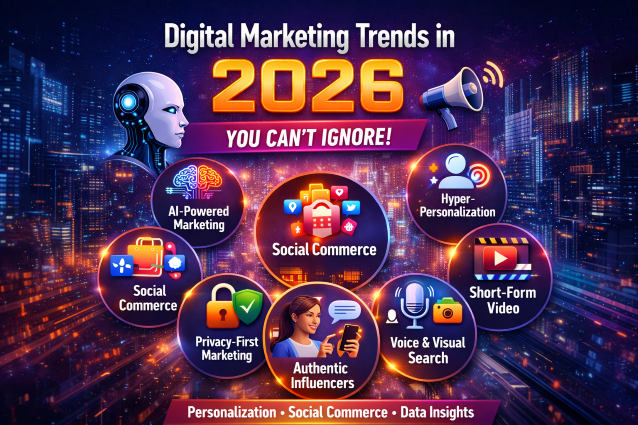
1. AI-Powered Marketing Becomes the New Standard
AI is no longer a “future trend”; it is the new foundation of digital marketing. Imagine having a marketing agency where the first draft of your blog, Facebook post, ad, and email campaigns are all created automatically in a matter of seconds by AI. Then you have your team refine, add personality, and set them up all with the absolute best AI tools for digital marketing. This isn’t science fiction; this is becoming the norm by 2026. Marketers today are using AI as part of their normal workflow, rather than just as a gimmick.
An example of AI being used now is for a mid-sized online retailer. They input product images and attributes into the AI platform, and the AI creates 20 versions of video ads for the same product for multiple target audiences. The AI then selects the top-performing video ads and automatically runs them across social media and connected TV, adjusting ad spend in real-time. Companies like Meta Platforms are looking to completely automate all aspects of ad creation and delivery by 2026.
2. Hyper-Personalization is Non-Negotiable
A further element of AI-enabled advertising and marketing is the potential for personalized content material at scale cheers to the above notion of straightforward call-in-project-line behavior patterns. By the year 2026, brands will start to expect consumers’ behavior and dynamically produce their content material in actual time to fulfill their customers’ alerts.
To illustrate this point, if one buyer is browsing an internet site that sells strolling footwear, adds an object to their cart, and then abandons the cart, the machine will be capable of identifying this behavior and shipping a personalized video message via email or push notifications, modifying the creative materials used inside this video based on the consumer’s device, location, and time zone, and providing the purchaser with a personalized promotional incentive, and all of this occurs inside one hour.
Consumers have demonstrated that they now expect the same or even better level of virtual experience when compared to engaging in person with retailers. In a contemporary survey, over 63% of consumers believe that the level of personalization they receive in a virtual environment should be as high as they would receive in-store. Brands that succeed will treat each purchaser as a unique customer experience rather than part of a group.
3. Short-Form Video Still Dominates
If you thought that short-form video was simply the latest trend, think again. These videos are expected to become the norm for engagement in 2026, with platforms like TikTok, Instagram Reels, and YouTube Shorts dominating user attention. A recent digital marketing report shows that 86% of advertisers are currently or planning on utilizing generative AI to create video ads and that by 2026 40% of all video ads will be generated through AI.
Why are short-form videos so powerful?
- A mobile-first experience: people scroll, swipe, and tap in quick bursts
- Short-form videos are easy to consume and share.
- They create a large emotional impact in a small amount of time.
- The algorithms favor new formats.
When it comes to their funnel(s) for short-form videos, brands should consider how to include short-form videos at each stage of the customer journey attention (15-30 seconds), interest (60 seconds), and conversion (90 seconds + testimonial) while considering ‘mobile sound off,’ captions, and vertical format.
4. Voice Search Optimization is Growing Rapidly
The digital marketing industry is quickly changing due to changes in search behavior. In particular, voice assistants such as Siri and Alexa enable users to make voice queries rather than simply typing in questions. An example of this change would be if a user asked a digital assistant for recommendations or a resource they would likely use either voice search (by verbally asking the assistant) or visual search (by scanning an image of a resource and searching for alternative resources using that image).
By 2026, these types of behaviors will be commonplace and will require marketers to change the way they create and optimise their content
Marketers will need to do the following to adjust to these changes:
- Develop written content that employs natural-sounding language (i.e., write in a way that mimics how humans actually communicate).
- Use longer phrases/keywords to improve search results for how users verbally communicate or pose questions.
- Create content that can easily be retrieved by audio and voice-related searches.
- Label and index images, videos, and any other visual asset correctly.
- Build websites that are easy to load and are mobile-friendly, allowing consumers to access their intended pages as quickly as possible through either voice or visual searches.
By the year 2026, content marketers will need to consider what potential consumers will “ask” rather than what they would type into a search engine, because digital marketing will be advancing in this direction.
6. Social Commerce is Exploding
As of 2026, the growth of social commerce, including the use of social media platforms and other types of websites as shopping venues (e.g., Instagram, Facebook Marketplace, TikTok Shop), is transformative and very rapid. Social media platforms that previously served only as platforms for socialization are now being used by users to discover, learn about, and buy products all without leaving the social media app. The use of in-app purchase functions, individual live shopping events, and sales driven by influencers are fueling the rapid change of the users’ buying journey from one that is slow, point-and-click to one that is very fast and interactive. As this shift continues, the separation between social media and eCommerce will continue to disappear, thus opening up new opportunities for brands to create content and generate direct sales through the content that they provide.
7. Privacy-First Marketing Takes Center Stage
In parallel, marketing with an emphasis on respecting consumer privacy has recently been identified as one of the main goals of many companies due to new laws about how companies handle (collect/use, etc.) consumer data. Companies have begun to rely more heavily upon using first-party data (data collected directly within the company’s own database) and transparent practices to build customer trust as third-party cookies begin to disappear. Marketers must, therefore, ethically collect customer data, navigate the use of such information by informing customers of how their data will be used, and build strong email databases (lists) as a means of reaching out to customers. As a result of this shift in focus toward customer trust, in today’s arena of digital marketing, trust has become the most valuable form of currency & therefore, brands that do not establish customer trust risk losing customer confidence.
8. Influencer Marketing Gets More Authentic
The influencer marketing landscape is changing as well, moving from endorsement of celebrities to more authentic, relatable collaborations instead. The rise in popularity of micro and nano influencers gives them the ability to connect to niche audiences on a much deeper level and to provide much higher engagement with consumers. The present day consumer values honesty, genuine experience, and authenticity over polished promotional material; therefore, this transition is changing how companies partner with influencers to ensure they are collaborating with an influencer that shares their company’s values and product needs.
9. Omnichannel Marketing is Essential
It is no longer an option but an essential way to provide customers with the best experience possible through whichever channel they interact with your Brand. Today’s consumers have many different ways to connect with Brands including Websites, including Social Media, Email, and through Messaging Apps such as WhatsApp. Organizations must establish an environment where consumers can expect the same experience at every touch point and will have a seamless and unified experience throughout their interaction with the Brand, no matter the place or time. A solid omnichannel strategy will provide an increase in customer satisfaction and enhance Brand recall and Trust.
10. Data-Driven Decisions Win
Using data to make decisions has transformed digital marketing. There are no longer any assumptions when it comes to being successful in a business environment that is constantly changing, and being able to make decisions based on knowledge is a must. Tracking the metrics of your marketing activities, such as conversion rates, LTV and engagement rates, will allow you to make decisions that improve performance and optimize your marketing activities. Analytics dashboards, heatmaps, and CRM systems allow marketers to look at user behavior through data to determine how to make beneficial decisions. If you do not track data in 2026, you will miss out on growth opportunities.
conclusion
As digital marketing continues its growth into the mid-2020s, a major trend emerging has been the emergence of personalization within marketing strategies, followed closely by authenticating services and providing access to digital content through integrated technology platforms for delivering digital media (i.e., videos, images). Companies that adapt quickly to the changes happening within the digital marketplace now will find themselves ahead of their competition in terms of gaining customers; whereas companies that do not keep pace with these trends risk becoming invisible as an increasing number of consumers use online shopping channels when seeking out products.