



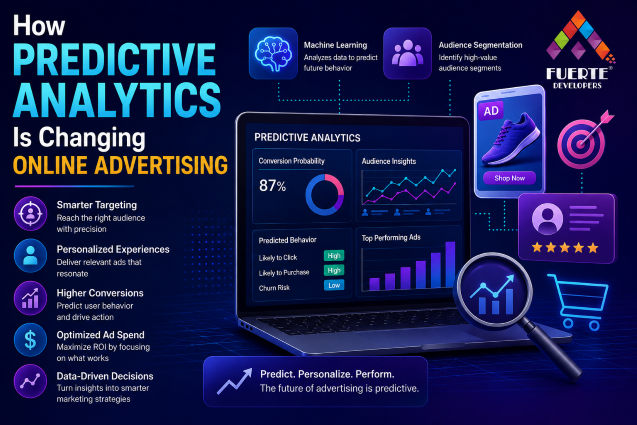
In the past ten years, online advertising has continued to evolve rapidly. Companies are increasingly moving away from relying solely on traditional targeting techniques or generalized demographic data for determining their marketing strategies to leveraging new technology that allows them to better understand what customers are doing and create advertisements that are tailored specifically to them. One of the most important developments in helping to achieve this goal will be represented in the form of predictive analytics.
Predictive analytics is the use of past data, customer interactions, and incentives to help marketers predict how customers will behave in the future. Within online advertising, this will allow marketers to identify the products and services that consumers are likely to purchase, the times of day that consumers are most likely to make purchases, and the formats or types of advertisements that consumers enjoy seeing.
We will explore how predictive analytics are shaping the future of online advertising and also define how predictive analytics work and how businesses are integrating predictive analytics into their overall marketing strategies.
What Is Predictive Analytics?
Predictive Analytics involves analysing historical data and incorporating AI technology, statistical algorithms and Machine Learning to forecast what may happen in the future, or how consumers will behave, including
- Browsing history
- Purchase behavior
- Social media activity
- Search patterns
- Device usage
- Geographic location
- Customer preferences
Using predictive analytics in digital marketing is now possible for agencies and businesses to review vast amounts of data on potential customers and then predict their likely activity or behavior to determine the best methods of advertising to potential customers.
Why Predictive Analytics Is Important in Online Advertising
Online advertising through traditional methods is targeted to a wide demographic while lacking an understanding of consumer intent. As a result, advertisers are left with ineffective spends and lower engagement levels.
Predictive analytics offers a solution to the generic approach to traditional advertising by developing accurate and data-based marketing efforts.
The Benefits of using Predictive Analytics for Advertising
1. Improved Audience Targeting
Using predictive analytics, advertisers can identify users that will engage with the brand’s products and/or services. Rather than targeting everyone with an advertisement, businesses will target the individuals who have the highest potential to purchase.
2. Better Customer Experience
Consumers enjoy receiving personalized advertisements based on their interests and needs. Predictive analytics helps marketers design personalized experiences, thus making the ads feel less like interruptions and more like something that is personally relevant.
3. Higher Conversion Rates
When digital ads are displayed to the correct audience at the most effective time, conversions are much more likely to occur than if the same ad were placed in front of the incorrect audience.
4. Reduced Advertising Costs
Businesses will see a greater return on investment for advertising dollars spent because they will advertise to users that are most likely to make a purchase from their business.
5. Real-Time Decision-Making
Real-time reporting and predictive tools provide advertisers with the capability to adjust their marketing efforts as they are related to consumer behaviors and digital advertisement performance.
How Predictive Analytics Is Transforming Online Advertising
1. Smarter Audience Targeting
Unlike traditional marketing tools that use age, gender, and locality parameters to segment customers, predictive analytics points the keen eye of advertisers to what has now evolved into windows into a customer’s intent based upon his behavior patterns.
Example
The predictive systems will probably detect that a user who generally conducts searches on fitness equipment, watches exercise videos, and visits relevant health sites is more inclined toward fitness products. Subsequently, they might start seeing ads related to gym memberships, supplements, or workout gear.
Such a layer of targeting is known to increase engagement and improve campaign results.
2. Personalized Advertising Experiences
Personalization is an increasingly significant component of online marketing strategies. Thanks to predictive analytics, companies can deliver personalized content as part of their advertising strategy.
- Product recommendations
- Email campaigns
- Social media ads
- Website content
- Video advertisements
Why Personalization Works
Ads that seem specific to the preferences and wants of a potential consumer provide the greatest chance of prompting action on the part of the customer. In addition, personalized ads build a greater emotional bond between businesses and their customers.
For instance, many e-commerce sites use prior purchase history or occasion information to make product suggestions based on previous online activity. Predictive analytics provides the underlying platform that powers these recommendations.
3. Predicting Customer Behavior
Predictive analytics allows businesses to foresee possible customer behavior in advance. Using trending data to analyze customer behavior will allow businesses to predict, for example, a customer’s likelihood of making a purchase, abandoning a shopping cart, cancelling a subscription, or interacting less with the company.
This predictive function gives marketers a proactive approach rather than a reactive approach when a customer decides to leave.
Example — Predictive analytics can also be used by subscription-based businesses to predict which customers are likely to cancel their subscriptions and give them retention offers before they actually cancel.
With the ability to use predictive advertising, businesses can build customer relationships and increase their sales at the same time.
4. Improving Advertising Efficiency
The costs of online advertisements can get out of hand if advertising campaigns have not been optimized properly. Predictive analytics is used to help businesses achieve a better return-on-investment from advertising campaigns by using statistical methods to analyze the overall effectiveness of advertising strategies.
A predictive analytics system will analyze data collected through numerous advertising campaigns and determine the various advertising platforms used, the best times to post advertisements, the best-performing creative pieces, and the audience segments that generate the highest conversion rates.
As businesses analyze the performance of their advertising campaigns, they will have the information necessary to make better marketing decisions and to avoid spending their marketing budgets on campaigns that are ineffective.
An example would be if predictive analytics indicated that an audience group has higher levels of engagement in advertising when the completed advertisement is live on the Internet in the evening hours or that certain methods of advertising perform better with mobile devices. Then, using this data, businesses can change their advertising campaigns to optimize advertising effectiveness.
The Role of Artificial Intelligence in Predictive Advertising
Artificial Intelligence Technology is the Backbone of Data-Driven Marketing
Marketing data analytics that has predictive capabilities is a direct result of utilizing artificial intelligence technologies.
1. Customer Segmentation
Artificial intelligence technologies utilize algorithms to segment customers into defined audience segments by analyzing relevant behavioral data and/or interest/expression data.
2. Product/Service Recommendation
Artificial intelligence uses predictive algorithms to identify the optimal ways to target users and recommend products or services based on their previous purchases.
3. Dynamic Creative Creation
Using demographic and customer profile information and the predictive algorithms used to classify customer segments, artificial intelligence creates advertising copy for users in real-time based on a combination of relevant user data or metrics associated with past ad performance.
4. Real-Time Adjustments to Advertising Campaigns
Artificial intelligence enables marketers to make real-time adjustments to ad performance by using performance metrics collected from individual advertising campaigns in order to maximize the effectiveness of their respective ad campaigns
Industries Benefiting From Predictive Advertising
- Online Shopping: Stores utilize predictive analytics in order to recommend products and create personalized shopping experiences for their customers.
- Healthcare Sector: Being able to analyze predictive trends allows healthcare providers to deliver specific health services as well as wellness products to audiences.
- Financial Institutions: Financial institutions utilize predictive analytics to determine which financial products will work well based on consumer behaviors.
- Video/Entertainment Streaming: Video and entertainment streaming companies utilize predictive behaviors of users in order to recommend movies, shows, and music selections.
- Travel Industry: Companies in the travel industry utilize predictive analytics in order to deliver customized vacation packages and deals.
Challenges of Predictive Analytics in Advertising
Predictive analytics has its advantages, but there are still hurdles to be crossed.
1. Data Privacy Concerns
There is growing concern among consumers that businesses will misuse their data. Companies are required to comply with privacy laws like GDPR, CCPA and Data Protection Policies and provide customers with transparency and fair use of their information.
2. Data Accuracy
Predictions are made largely based on the existence of good data or a lack of it.
3. High Implementation Costs
The costs of deploying higher-end Predictive Analytics Software is prohibitive for smaller firms, but as technology becomes available at a lower cost, more businesses are implementing lower cost solutions.
4. Constantly Changing Consumer Behavior
Consumer behavior is not static; therefore, predictive systems will have to continually update to learn about the newer data to provide accurate predictions.
Conclusion
Using predictive analytics is rapidly changing the world of online advertising by allowing advertisers to create smarter, more personalized, and efficient campaigns. Organizations now have a much deeper understanding of their customers’ behaviors and can therefore improve their audience targeting, optimize their advertising spending, and create highly relevant experiences for their potential customers.
By leveraging artificial intelligence (AI) and machine learning together with predictive advertising, organizations can take advantage of even more powerful capabilities being realized from predictive analytics. This means that organizations that invest in adopting predictive analytics will be in a better position to compete in the ever-evolving digital world.
In today’s rapidly evolving online environment, predictive analytics has transitioned from being simply an advanced marketing tool; it has become a required component of any successful digital advertising strategy to connect with customers better and to continue to grow their business well into the future.