


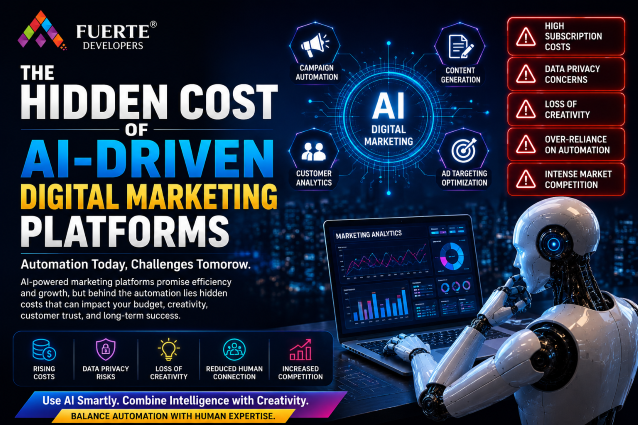
Artificial Intelligence has changed the face of the digital marketing industry in a very short period of time. Today, many businesses are utilizing AI-based platforms for everything from creating content to targeting customers, managing their social media accounts, optimizing for search engines, using chatbots, and automating their advertising efforts. These technologies help businesses to become more productive, save time, and better manage their overall marketing efforts. But while there are benefits to using AI Marketing Platforms, there are also many costs associated with them that businesses do not realize until after they have paid for them.
Many companies think that by purchasing AI Tools will allow for instant success in their marketing efforts, that they can fully automate their marketing efforts, and that this will result in huge growth for their businesses. While automation provides faster and more accurate data analysis, relying on AI too much can create long-term financial, operational, and creative problems for companies.
The Hidden Cost of Increased Subscriptions and Operating Expenses
One of the largest hidden costs of AI-enabled marketing software programs is the cost of the subscription fee to access the software program. AI has a wide range of monthly or yearly subscription fees for advanced AI software where a small business signs up for a basic plan for low-cost access monthly or yearly, but as the business expands its needs for AI tools, it will need to pay for a premium plan, which will include advanced features, additional data access, analytics, and automation.
As time passes, these expenses can add up to a much greater total cost than the business anticipated. The business will likely pay for the costs of different AI tools like AI content tools, SEO tools, marketing automation tools, social media scheduling tools, CRM tools, and Ad management tools separately. Businesses may find themselves spending far more than they originally thought they would when they decided to invest in AI tools for their business.
Loss of Creativity and Brand Originality
AI systems are capable of automating certain repetitive tasks, but they do not replace human creativity or emotional intelligence. Many businesses use similar AI technologies to put out repetitive types of marketing content, providing little in the way of uniqueness or originality.
Most automated content is produced using repetitive patterns; hence, the advertising industry, blogging, email, and social media strategies produced through an AI-driven process become indistinguishable among industries over time. This can weaken the identity of brands, as well as their ability to maintain customer loyalty. Emotional Branding and Creative Storytelling requires human imagination and strategic creativity skills. Businesses that are heavily reliant on AI-generated marketing strategies often find it challenging to form a strong emotional connection with their customers.
Risks Involved with Data Protection & Security
AI-based marketing platforms use a lot of customer information in order for marketing to occur on a more precise level. Businesses routinely share very personal data about their customers through third-party systems to assist in analysis, automate processes, and enhance their marketing efforts through A/B testing.
Sharing this much personal data increases the opportunity of there being issues with data protection & security. The result of an incident occurring, such as a data breach, unauthorized access, or using customer information inappropriately, may not only negatively impact the company’s reputation but also can result in customers losing confidence in the business doing the marketing.
Companies that operate with AI technology also are required by law to follow data protection and privacy regulations. Following these laws will require organizations to invest resources to comply with data protection laws and provide adequate cybersecurity measures.
As AI continues to gather vast amounts of user information, it is necessary for businesses utilizing the technology to have a solid protocol regarding how their data will be collected, stored, processed, and secured end-to-end throughout the entire data lifecycle.
AI Still Requires Human Supervision
Most businesses believe that using an AI program would allow them to fully automate their marketing efforts, but this isn’t the case. Marketing will always need to be monitored and strategically planned by a human being.
AI can sometimes produce poor-quality content, bad recommendations, and repetitive messaging and not target the right customers. AI can also misinterpret customer behavior and fail to respond to changes in market trends.
Automated business marketing is performed without a human overseeing the course of action, which may negatively affect brand reputation and the effectiveness of the overall marketing effort. Businesses must have trained marketing professionals manage their marketing efforts, create strategy, and monitor the quality of materials produced in these campaigns.
Increasing Competition in Digital Marketing
As artificial intelligence tools gain wider accessibility, competition among digital marketers has grown increasingly competitive. The fact that businesses can launch their campaigns faster and produce a larger volume of content automatically means their efficiencies have greatly improved, but also, correspondingly, market saturation has increased.
As the result of more brands competing for the same audience with similar automated methods, businesses are also experiencing increasing advertising costs, competition for keywords, and having to spend more money to acquire new customers.
To remain competitive, businesses will need to be developing more of their investments in branding, creativity, and developing personalized customer experiences, rather than relying on just automation.
Reduced Human Connection with Customers
Customers nowadays want real & significant conversations with brands. AI chatbots & automated systems can increase response time, but they cannot substitute for real human communication entirely.
Automation overuse can cause customer experiences to be robotic or impersonal. Companies relying heavily on AI for providing customer service may have difficulty establishing trust & building long-term relationships with their customers.
Human interaction is still needed to comprehend feelings, handle complicated customers’ complaints & develop individualized experiences that enhance the loyalty of their customers.
Finding the Right Balance Between AI and Human Expertise
Most of the leading businesses today are integrating Artificial Intelligence technologies with human creativity and strategic thought. Rather than replacing their marketing teams altogether, these business leaders recognize that human professionals are still integral to many aspects of the marketing process. AI is capable of performing many tasks in the marketing realm: it can automate repeated tasks; analyze large volumes of data to identify patterns and insights; create efficiencies within an organization; and aid in making strategic decisions. On the other hand, human marketers can create compelling advertising copy and campaigns, tell interesting stories about their products or services, build an emotional attachment with consumers, and manage customer relationships. Businesses that utilize both when integrating AI and human resources will ultimately achieve a higher level of sustainable growth and greater overall brand position.
Conclusion
AI-driven Digital Marketing Platforms are changing how businesses target their customers online, automate their marketing campaigns, and execute their marketing strategies. The efficiencies and scalability offered by these technologies have many advantages in comparison to traditional methods; however, there are hidden costs related to subscription fees, creativity, competitive advantage, privacy, and building/maintaining effective customer relationships.
Organizations should see AI as an effective support mechanism and not a substitute for human knowledge. Organizations that combine intelligent automation with innovative strategies and genuine communication will have a superior chance of thriving under the ongoing transformation of the digital marketing environment.